Why facilitated conversations get leadership teams to the honest answers
After a facilitated conversation with a leadership team, I often hear some version of:
"that's the most honest business conversation we've had."
This feedback comes from companies across the board from established practices to start-ups. Then they ask how to do it again.
So here's what happens in the room to make this happen.
Most leadership teams already have the expertise and plenty of ideas. What they rarely get is time together to agree out loud on the hard questions.
What are we known for?
Who are we really competing against?
Where's the work coming from in three years' time?
Everyone carries a version of the answer around in their head, and the job is to find out whether it's the same version.
And while these conversations start with marketing, they soon reach most other parts of the business. Positioning leads to pipeline, pipeline leads to people and resourcing, and before long you're talking about the shape of the business itself. That’s why I firmly believe that marketing is a key driver of all businesses.
How a facilitated conversation works
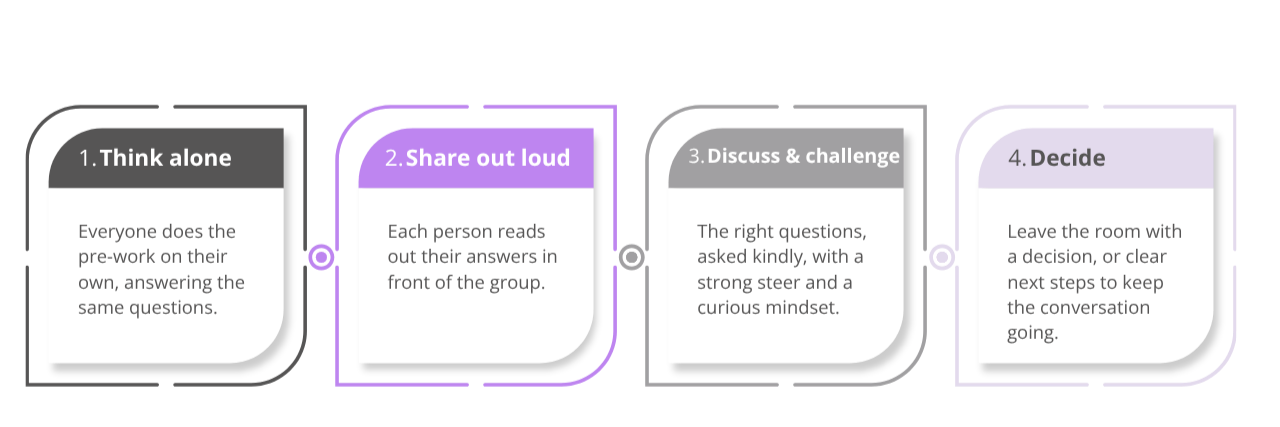
Four steps to get a leadership team to an honest, shared answer
1. Think alone
Before we meet, everyone does the pre-work on their own and answers the same set of questions. That gives you each person's own view, before anyone gets swayed by the most senior person or the loudest voice.
The questions vary depending on the team, but they're designed to get specific quickly. For example:
Name up to ten clients you'd most like to be working with in two years' time, existing or new, and why.
What are you spending marketing and BD time on now, including events, and what is it actually bringing in?
If the business had to turn down one type of work or marketing activity next year, what would it be?
Who are your main competitors, what do you do better than them, and what do they do better than you?
That last one is always revealing. Most teams find the first half easy and the second half much harder.
2. Share out loud
In the session, each person reads out what they wrote, in front of everyone. It can feel a bit exposing at first. It's also the moment the gaps show up. You see very quickly where people are aligned and where they're miles apart.
3. Discuss and challenge
This is where I come in with probing questions to drive the conversation forward. What do we want to be known for? Who are we really up against? What happens to the pipeline if the founder steps back from bringing in the work? What if we do hit that number? What needs to be in place? I keep it kind, but I'll push. If something's vague, we stay on it until it's clear.
4. Decide
Everything drives towards decisions. Often that means agreeing what we're going after, what we're stepping back from, and who owns what. And even when the final call comes later, the seeds of inclusive discussion and decision-making have been sown. The underlying issues come to the surface, along with the impact of each possible pathway. That's a big deal in itself, because it means you're on the right road.
Can you do this yourselves?
Partly, yes. The structure helps a lot: individual pre-work, sharing before discussing, and a firm focus on decisions. What's harder to do internally is ask the awkward questions when you're one of the people around the table. That's where a facilitated conversation, with someone from outside running it, makes a real difference. They bring thier own skills, experiences and energy to the conversation and have the benefit of being an outsider with independence.
If your leadership team is due a facilitated conversation about where the business is heading, and how your marketing and BD backs that up, get in touch.

Thanks for reading
Ayo Abbas is a strategic marketing consultant, speaker and trainer working with architecture and engineering firms.
Sign up to The Built Environment Round-Up to get this sort of thing straight to your inbox.