Ep 96: Are you networking in the right rooms?
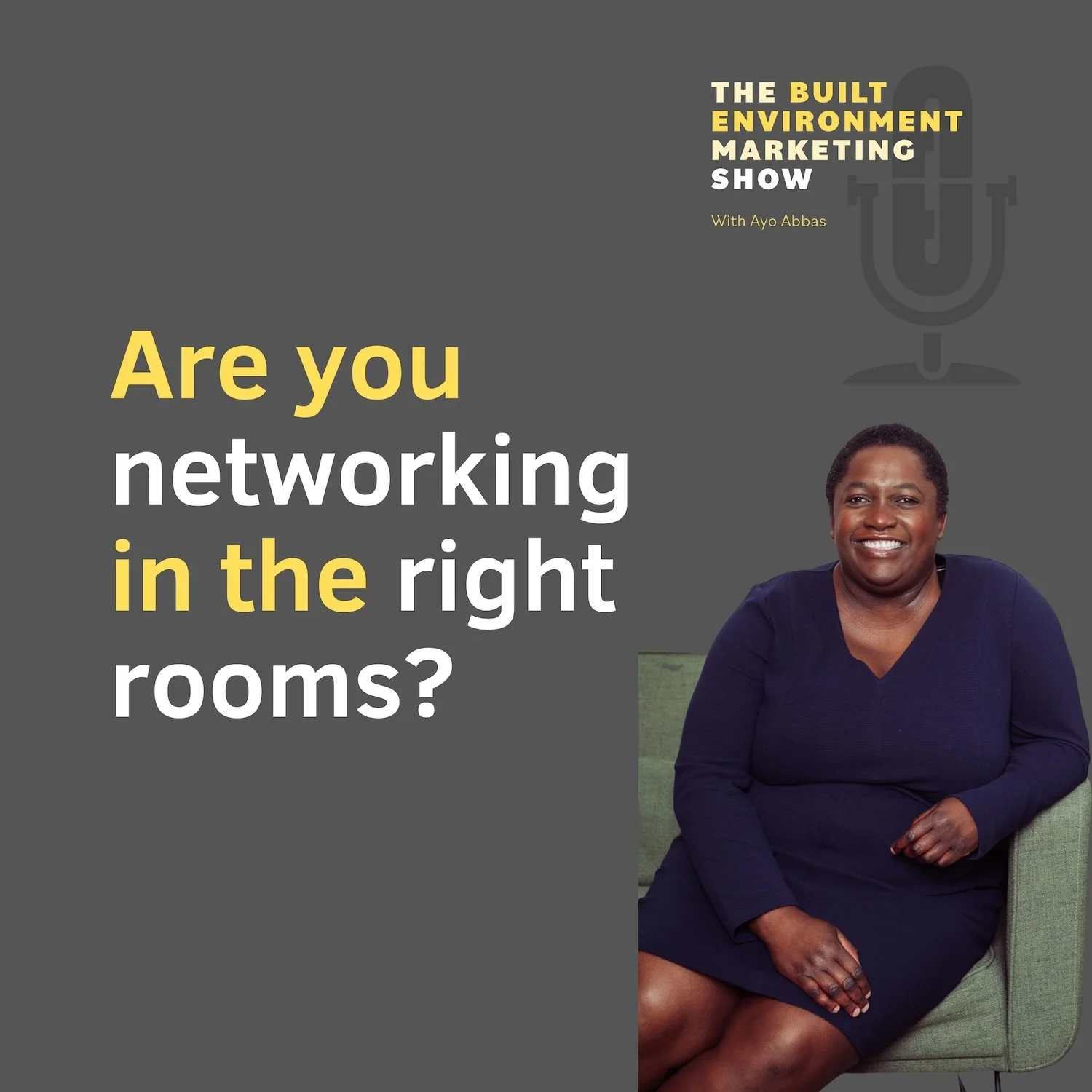
Welcome to The Built Environment Marketing Show.
Most built environment firms know networking matters but are they actually in the right rooms? In this solo episode, I share a real decision I had to make between two events on the same day, and why choosing the less familiar option led to two potential project conversations by the time I got home.
This episode looks at why strategic networking has to match your positioning and what happens when it doesn't.
If you're an architect, engineer, or consultant spending time going to events that aren't converting, this one's for you.Key takeaways
Key takeaways
Your networking strategy should directly reflect your positioning
Being 'out there' isn't enough. Visibility only counts when you're visible to the right people
Most firms are spending the majority of their networking time with competitors
Strategic networking comes down to three things happening at once: the right decision makers, at the right time, in the right context
The firms winning better work at better fees go to fewer events — but they make each one count. Focus beats volume every time
Links
About the show
The Built Environment Marketing Show is hosted by marketing consultant and content creator Ayo Abbas from Abbas Marketing. It is a show that is unashamedly about marketing for architects and engineers, as well as bringing forward voices that we don't always get to hear.
BOOK A CALL TO TALK ABOUT WORKING WITH ME IN 2026
Ways you can support this show
📲 Share about the show on socials
🔗 Follow us on Apple or Spotify
📝 Leave us a review on Apple or Spotify
💬 Tell a friend about the show who you think will benefit.
More podcasts.









Transcript
Ayo Abbas 00:03
Ayo, hello and welcome to the latest episode of The Built Environment MarketingSshow hosted by me. Ayo Abbas, I am a marketing consultant, speaker and trainer, and I specifically work with built environment firms. I've worked with a number of firms for 25 years, and I do a range of services, from consulting to advisory sessions. Also do training on how to use tools like LinkedIn and such, such like anyway. Today, I wanted to focus this episode to talk about networking. It's something that we all have to do, whether we like it or not. And I wanted to talk about networking and whether it actually matches your positioning. Something happened to me a few weeks ago that I really kind of wanted to share with you, and it really crystallised my belief that I think most firms in effect, in the sector know that networking is important, but I think there's something they were always getting slightly wrong. So in terms of what happened to me a few weeks ago, I had to choose between two events on the same day. The first option was actually amazing event in Edinburgh, record adventures in marketing. It's an annual event. I've been going a couple of years. I've even spoke on the stage. I've kind of been part of the kind of workshop tables, all of that standard stuff, amazing energy, hosted by Abi Sea and Niki Hutchison, who I really, really do rate. It's a brilliant, brilliant marketing event. So it's something I've really enjoyed myself. I felt part of that community, and the audience is predominantly marketers, creators, podcasters, kind of a really broad mix of people, and it's absolutely lovely from across the UK. But I guess in many ways, it's mainly founders, people who are running their own businesses and having to do the marketing and having to do everything else. And the second option was, I guess, a bit more kind of unknown. It was actually a networking reception being hosted by the City of London Corporation for their arts and culture committee at the Guild Hall in London. So yeah, very prestigious venue. Didn't really know what the format was going to be, but I had to kind of RSVP very early on. And yeah, there's just lots of people from arts and culture organisations, cultural institutions and kind of government kind of bodies, that kind of stuff. So that was my decision. Where do I go? Where do I spend my time Edinburgh? I do absolutely love and I hadn't bought a ticket yet, but I had planned to. I kind of had to sit there and kind of do that thing of looking at, where would I get the most bang for my buck? Yes, I would learn some new things in Edinburgh, and I'd have a brilliant time. But actually, I knew that in my heart that really where I needed to be was at that Guildhall event. And if I'm being perfectly honest, it was completely the right move for my business. The event was buzzing. Everyone was really geared up for networking, which is a great thing, but also, I think the main fact for me was everyone was wanting to have conversations, wanting to meet new people, and I had loads of interesting conversations, but also a lot of people were there to do business, and they were actually people who could purchase from me, and I think that's a difference. So by the time I got home, I actually had two messages about potential projects. So, you know, I go out quite a bit for my business, and that doesn't happen that often. So you know, I was in a room full of people who could commission work, or many of those people could commission work. Other people were artists or consultants like me. So yeah, there's a broad mix of people, but people in that room were far more aligned to my ideal target audience, which is the most important part. So why is this important? Well, to me, all of this ties in with one of my beliefs, that when you're networking, should really match your positioning, where you choose to put your full energy impacts, what you get back and Yeah, after 25 years doing this, I've realized that most firms are actually getting this wrong. When I'm working with architects and engineers on the business development aspects of their marketing strategies, I always ask, you know, where do you go out? Where do you network? And it's really telling what their senior leaders, senior leaders actually respond back to me, you know, and let's be honest, your diary doesn't lie. Where are you going. So for example, if you're an architecture firm and you want more commercial work, but actually there's places that you spend more time are in rooms with other architects, or doing the awards with other architects. They're basically you're in rooms of your competition. So rather than heading out to places where your ideal clients actually are hanging out, you are heading to spaces where your competitors are. So yes, you might feel more comfortable and it might feel safer, but are you in the right space? And I think the other thing are, you know. Another example would be a firm who would, you know, want to have a higher, higher value clients, but they're actually networking with people who don't handle those types of budgets, or they don't have the authority for those types of budgets. So as you can hear, there's a strategic disconnect between what they say and what they actually do, if what you're doing is not where you actually really want to be, it's really kind of easy to fall into this trap where you just think, Oh, I'm doing the right things. I'm out there, I'm being out there, but really the needle is not moving. And yes, it's all too easy just to stay within your own comfort zone. But a big thing for me is doing the work on understanding and identifying your client, your ideal client, but also doing the legwork to understand where they actually tend to hang out. And if you can't identify where they hang out, then you've got a major problem. So for me, doing that basic, that fundamental work, and making sure that you understand commercially, what they look like, where they hang out, who's got that kind of authority to actually commission work is so, so important. And yeah, I know there's this whole thing around, build your personal brand, be out there, have visibility, and that's how you're going to get commercial success. Be everywhere, be seen, be front of mind. But if you're not visible in the right places, what is the point? You've got to be in front of the right audiences. What I constantly, constantly see, is that practices are burning lots of money and time and effort on going to events that don't really matter, or, you know, being here, there and everywhere, and actually nothing is converting because you're not talking to the right people. So it's, you know, the real problem here is got to be your focus, or your lack thereof. Focus, when there's no real clear, strategic positioning and clarity, you end up trying to appeal to everyone, which means you end up everywhere and really appeal to say, no one. So what does strategic networking actually look like? It means being in front of the right decision makers at the right time with the right context. That's the three things you need to get right simultaneously. So what does right decision makers mean? It means the actual people who commission work, or those people who actually could refer you to those people, those people influence those decisions. They'll be at specific organisations. They'll have specific roles and job titles. That have specific, specific challenges, can't say that that they're trying to solve. So not just people in the industry, they're people, and they have a role and a purpose the right time. So it's when they're actively looking about the problems that you want to solve, the sectors you work in, the challenges you address. Remember the 95 five rule. 95% of clients are not in the market for many goods or services at any one time. So that means you've got 5% of the time when they're actually ready to buy, which means you've got to be out there and keep in contact and the right context, an environment where substantive, where relationships are important. The Guildhall event worked really well because everybody was geared up for networking and they wanted to have conversations. So I was putting myself in the context of the right audience at the right time. So for me, that's it. Think about the context of where you're going, and all three of these things actually really matter. If you miss any of them, you're just burning time and energy and even money. So when I'm working with a consultancy firm or an architectural engineering firm, and we're looking at their kind of be, the approaches, and how they're going to get to where they need to be, some of the questions I would ask are, can you name five specific events or communities where your ideal clients will hang out. To be really specific, where they you know what these events are, when they happen, how you can be part of it. Really go granular. What are they? Are you going to this, certain movers and shakers, breakfast? Are you doing this? Just really get granular. The next question to ask is, do your partners know who they should be talking to this quarter those specific organisations, you're targeting the types of decision makers within those audiences and those specific opportunities or challenges that they're facing. It's not that just that you need to find more working education. It's about how you're going to go about finding it. If they don't know what you're doing is just reactive. You're waiting for opportunities to appear, and let's be honest in this marketplace, that's not happening.
Ayo Abbas 09:49
The next question, I would say, is, what proportion of your networking time is spent with people who can actually commission your work? Be honest and track it for a month, and I bet. At you, it's probably under 30% for most firms, so that means 70% of your BD effort is going to the wrong places. So if you just, if you just adjust that a bit, imagine how much more pipeline and more strategic discussions you could end up having. So to me, when it becomes comes to networking, the practices that are really getting this right are mega focused. This means they are going to fewer events, but making them impact much, much better with the right plan in place, they've defined their target audiences specifically enough that they know what their own messaging is. They can identify who's there and why they're there and those conversations they should be having with. They know which types of developers are working in which sectors and what challenges they're facing. They've done that legwork. They've built relationships with the right organisations that bring these clients together. They're part of the industry bodies that matter. They're part of the associations and networks. They understand the whole ecosystem of that area. There's even things like WhatsApp groups, you know, sometimes there's little private groups that people refer to each other. Which ones should you understand and know about? You might not be able to participate, but actually you could just be there and listen anyway, the firms that are winning are, you know, creating those small, round tables, those sector briefings, those technical seminars, the things that bring those right people together, those people can actually influence and shift the dial of you when in work. And what does that mean for you if you pull up your calendar right now, look at the next three months. Where are you going? Networking wise. Are you going to industry gatherings? What communities are you committing to where are you spending your time? How be a bit brutal for each one. Can you honestly say that at least I don't know, a third or even half of those people will be your target audience, the people who commission work from you. Or are they people that can introduce you to people who do? If the answer is no, you've got a bit of a positioning problem. And I think that's the whole thing that we all need to address. You don't want to end up everywhere because you'll be exhausted. We all know that. But actually, the firms that win better work at better fees are the ones who who are crystal clear about who they are, who they serve, and what problems they solve, and also where these firms actually are. They know where clients are. They know what they need. They know how to show up to them. They also show up to them consistently with something valuable to say. So that's what it means when your networking matches your positioning. Are you networking in the right places? If you've been listening to this episode, and a few bells are ringing about it, I think you know what you should do is look at the next month and just audit what you're doing. Are you in the right places? Are you seeing the types of clients and sectors that you want to be working with? Are you getting yourself out there? How could you make it happen more for yourself. And if you do need a hand in this, do reach out and give me a buzz. Ayo Abbas marketing.com because let's be honest, you've got to start to get yourself out there. And if you want to understand what events are out there and what people you should be talking to, and how I've got some great lists and some great examples that I can work with you on. So do reach out Ayo Abbas marketing.com if you would like some help with this. Thanks so much for listening to The Built Environment Marketing Show. If you've liked what you've heard, please do share it with others on social media, as it helps me to spread the word. Thanks so much. You.