Architects and engineers don't speak your clients language and here’s how to fix it.

Here's a problem I see constantly across architecture and engineering practices: the language you use to describe your work is not the language your clients use to describe their problem.
It sounds simple. But it's where most technical professionals quietly lose work — not because they're not good enough, but because the right people can't see themselves in the way the firm talks about what it does.
The language gap in practice
When a homeowner wants to improve their property, they are not searching for "retrofit coordinator" or "EnerPHit standard." They're searching for "eco renovation," "how to get rid of damp," or "why is my house always cold."
When a business owner wants to improve their office space, they're not thinking about "M&E coordination" or "BREEAM rating." They're thinking about energy bills, staff comfort, or getting planning through faster.
When a developer wants to find an architect, they're unlikely to search for "RIBA Stage 3 delivery." They want someone who can manage a complex project, hit planning milestones, and not surprise them with costs.
Your expertise sits on one side of this gap. Your client's problem sits on the other. Good marketing closes it.
A practical illustration
Here's how the same work sounds in two different languages. This example is from the retrofit sector, but the principle holds across the built environment:
If you're talking to homeowners If you're talking to professionals or funders
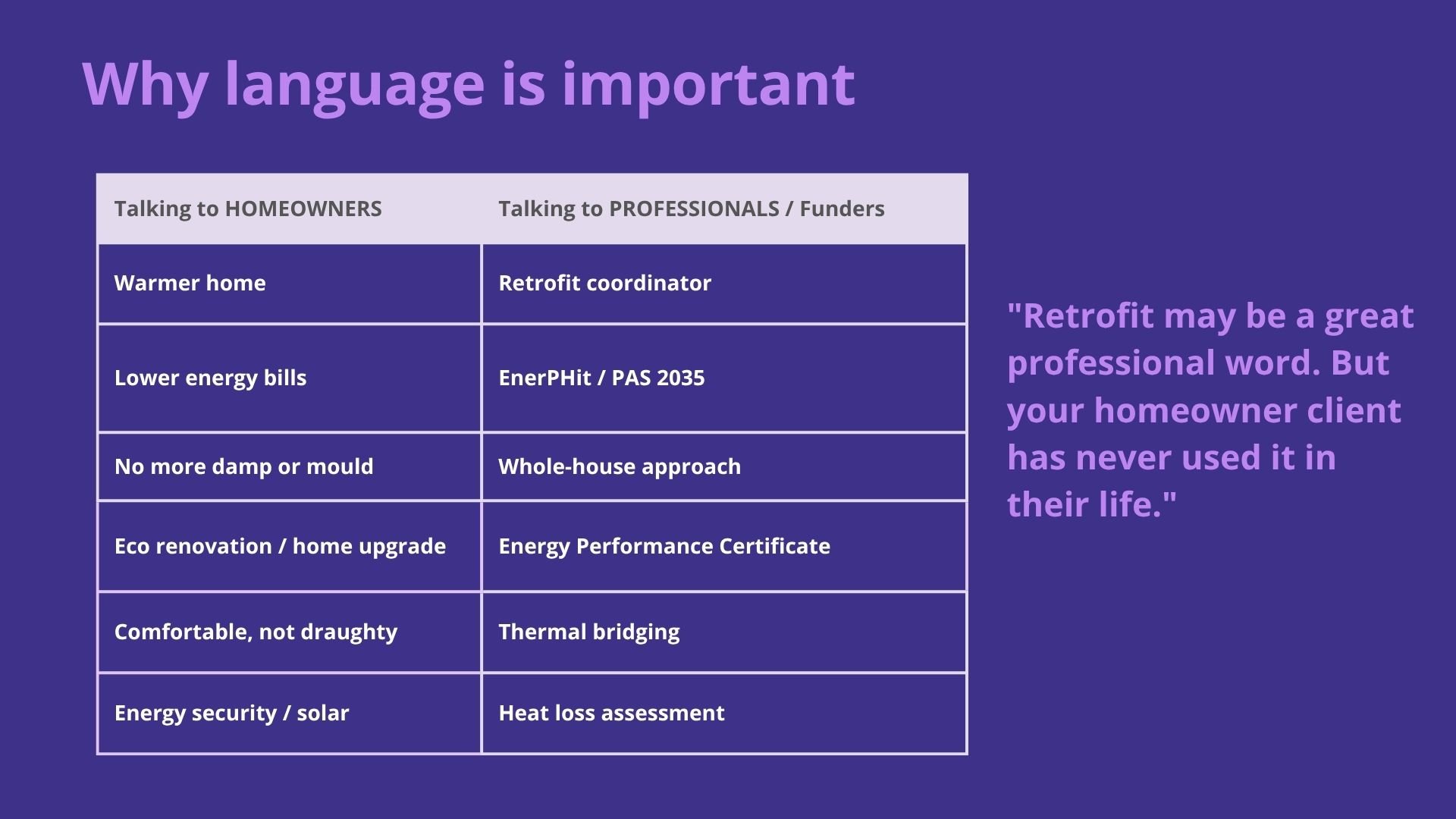
Neither column above is wrong. Both describe real, valuable work. But use the right-hand column with a homeowner audience and you will lose them in the first sentence.
The same dynamic plays out in architecture and engineering constantly. A firm describing its process in RIBA stages when a client just wants to know what happens after they sign, and when they'll get planning permission. A structural engineer leading with load calculations when a client wants reassurance that the building won't cost a fortune to run.
This doesn't mean dumbing things down
It means starting where your client is, not where you are.
If your audience is procurement leads, technical directors, or fellow professionals, specialist language signals credibility and is exactly right. But if you're talking to the person commissioning the project, often someone without a technical background, the words that work are the ones that describe how they experience the problem.
The practical question to ask is: would my ideal client use this phrase in everyday conversation? If the answer is no, there's a better way in.
Where the language gap shows up most
The language gap tends to be most visible in three places:
Your website homepage - most built environment firms describe what they do in terms of their services and capabilities. Clients are looking for evidence that you understand their situation. Those are different things.
Your LinkedIn profile or company page - if the first line reads like an internal job description, it's written for the wrong audience.
Your case studies - most describe outputs, what was designed, what was built, what was surveyed. The clients reading them want outcomes, what changed, what it cost, what problem it solved so that they can relate the case study to their own problems.
A quick language gap test
Read your website homepage as if you are your ideal client rather than a fellow professional. You know the actual people you want to hire you.
Does it speak to what they're worried about? Does it use words they'd recognise? And therefore search for. Does it make it immediately obvious that you're the right person for their situation?
If not, that's the place to start. Full rebrands and new websites often aren’t really necessary. Just a rewrite of the words that are already there, starting from the client's problem rather than your own expertise.
Related content and services
Three things stopping architects winning the work they really want
How to win your first architecture clients as a new practice

Thanks for reading
If you want to get clear on what's actually working in your marketing and what's just noise, that's exactly what I do. I work with AEC Directors and marketing leads to deliver strategic marketing that helps you compete. Email ayo@abbasmarketing.com