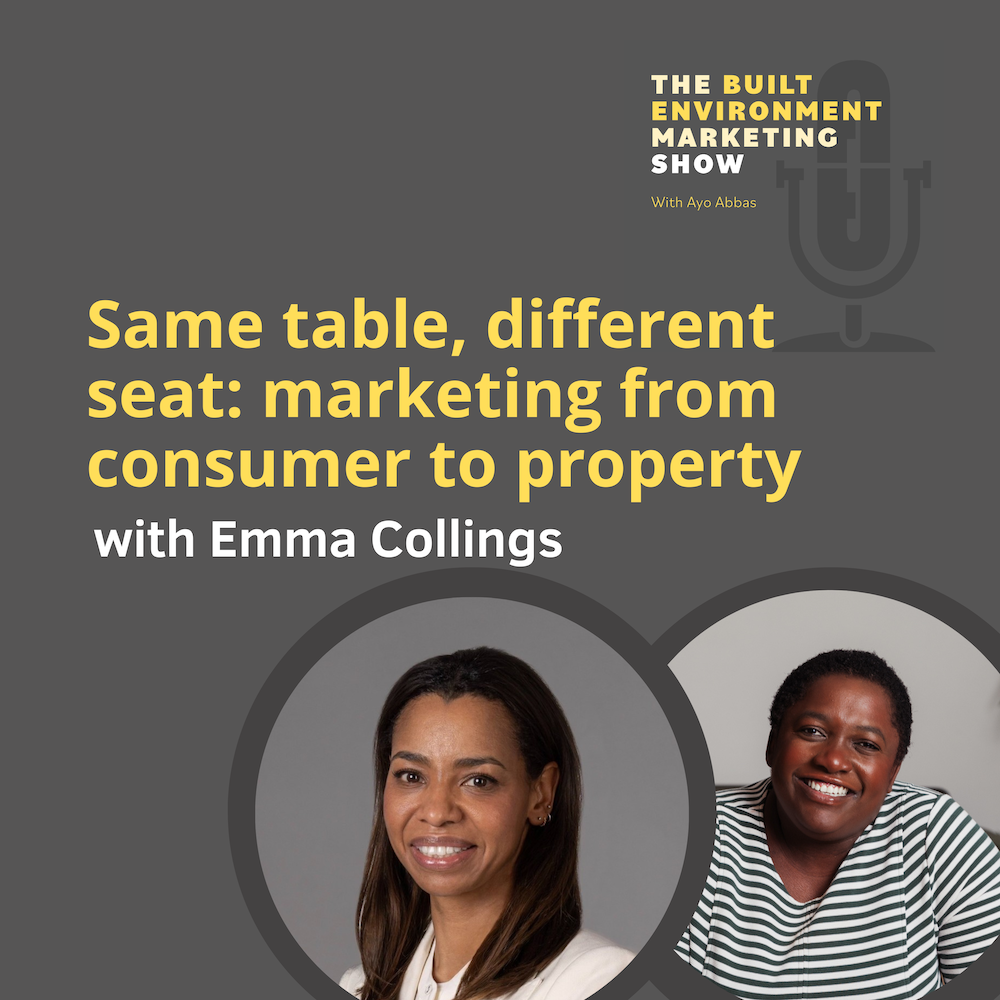
What happens when you bring consumer marketing thinking into property? In this episode, Ayo talks to Emma Collings,
executive director at Colliers UK, who leads its marketing communications team. Colliers is a property consultancy that advises clients on everything from offices and retail to hotels and automotive.
Emma has worked across law, social enterprise, Pandora and nearly a decade at British Land before joining Colliers. In consumer marketing you’re ruthlessly focused on the customer, and it shows up in your numbers every Monday morning. In
property, decisions can stand for 10, 20, 30 or even 100 years. The common thread throughout Emma's career journey is
staying obsessed with who you’re doing it for. As Emma puts it, it’s the same table, just a different seat.
In this episode we cover:
Same table, different seat: how law, Pandora, British Land and Colliers connect
What changes when you move from consumer to property marketing
Why marketing is often first to the table in consumer, and one of the last in property
Leading with how a message will land with your audience
Listening first: how she spent her first 90 days at Colliers
Bringing digital and physical together in her team
The question to ask any software provider before you sign up
Why marketing is a growth department
What agents value most from architects and engineers
Links and resources
Squiggly Careers - Amazing If
About the show
The Built Environment Marketing Show is hosted by Ayo Abbas. It is a show that is unashamedly about marketing for architects and engineers, as well as bringing forward voices that we don't always get to hear.
BOOK A CALL TO TALK ABOUT WORKING WITH ME IN 2026
Ways you can support this show
📲 Share about the show on socials
🔗 Follow us on Apple or Spotify
📝 Leave us a review on Apple or Spotify
💬 Tell a friend about the show who you think will benefit.
More podcasts.







Transcript
Ayo Abbas 0:05
Hello and welcome to the Built Environment Marketing Show, hosted by me, Ayo Abbas. I am a strategic marketing consultant. I work with architects and engineers across the UK as well as internationally now and then. So today, I have been trying to meet with this person at various events in the industry, at UK Reef specifically, but I'd never actually managed it. But she's actually agreed to come to the show, which is really great. Her name is Emma Collings, and she is now the executive director at Colliers UK, and she leads their marketing communications team. Colliers is a property consultancy that advises clients on everything from offices and retail to hotels and automotive. So this one I thought was really important because if I'm honest, a lot of people I work with in architecture and engineering don't necessarily understand the world of agents, and that is me me included as well. I have to admit. So what I wanted to do was shine a light on agents, what they need, how they work, what they do, so they can help us as well to understand more about how we can work with them, but also how we can also help their clients. So it's a really, really interesting conversation. Emma actually joined Colliers from British Land, and before that, she's worked for Pandora. She's worked for a law firm, so she's got such a brilliant, varied career. So what I also talk about is how she's kind of navigated all these different worlds and what joins them together, and she puts it all so succinctly as well, which is really lovely in terms of we're all at the same table, but it's very much you just look at it from a different seat, which I really loved. We also talk a lot about how she manages the team, how she structures it, and also what she's done in herself in her first 90 days, and what she's looking forward to doing in her new role. It's a really lovely listen, and I really want to thank Emma for her time. And I hope you enjoy listening. Enjoy.
Ayo Abbas 1:57
Hi, Emma. Thanks so much for coming on to the show. Can you introduce yourself and your role at Colliers.
Emma Collings 2:01
Yes, I'm Emma Collings. I'm an executive director at Colliers UK, and I lead marketing communications. Colliers is a property consultancy, and we help and advise clients to make the right property decisions for commercial outcomes.
Ayo Abbas 2:15
Fantastic. And so, who are who are Colliers's clients then?
Emma Collings 2:19
It's really varied. It could be anyone from like a hotel investor through to a blue chip company. So it really depends on which area of property you are we're advising on. And talking about advising on that, we could be retail offices, automotive, hotels. It's a real mix. And if you look at the property life cycle, it's everything from funding, you know, your cap markets piece through to your operational property management.
Ayo Abbas 2:42
Wow, that's a very kind of broad, encompassing role and work that they do. So, how did you kind of get into that role and that kind of field and area? What's your background?
Emma Collings 2:51
So, it's a very varied background. Actually, I've started in law, so right at the bottom, coming out of university, moved into social enterprise, into retail into British Land, which is where the property connection started to come in, and then into Colliers. And I've been here just over just over seven months now.
Ayo Abbas 3:09
That's amazing. And when you've worked across those kind of, I guess, so many different kind of varied sectors from B2C as well as to kind of more on the B2B side, how I guess how have you found it different? What's kind of tied things together, and what's been very different between.
Emma Collings 3:23
What's different. Well, I suppose the type of money that you're dealing with can really vary. You're making decisions in property that can stand for 10, 20, 30, hopefully 100 years if you if you take where property goes.
Ayo Abbas 3:35
Yeah.
Emma Collings 3:36
That said, the similarity is you're always looking at the client or the customer or the consumer. So if you if you keep really obsessed with who you're doing this for, you will you will find the right way.
Ayo Abbas 3:46
As a consultant, I'm often saying to my clients, "Can you put yourself into your client shoes?" Because I I think quite often it's quite easy just to focus on yourself. How have you found kind of taking that into a company like Colliers and property companies in general?
Emma Collings 4:00
Our job in marketing communications is to understand the story that you're going to tell and how it's going to land. And I always lead with how it's going to land, which is what is your audience going to think about it. So you have to put yourself into the shoes of the of of the person that you're advising or the the business. It's it's that's crucial. That's that's the biggest part of what we do, really.
Ayo Abbas 4:19
So career wise, why did you kind of decide to move across different industries rather than stay in one niche? I've like been in this sector for like 25 years, so let me let me say that.
Emma Collings 4:30
Hindsight would say I didn't make any decisions. I kind of went on a bit of an adventure, and as doors started to open, I you know walked through them.
Ayo Abbas 4:37
Yeah,
Emma Collings 4:37
The reality is it came back to people. They were interesting people to work with. There were interesting audiences and markets to work with, and from that, you just if you can work with great people, which I have been able to do, you'll you'll enjoy what you're what you're doing. So I never really saw it as being going from industry to industry. Actually, they are very connected. So law was about the big deals. If you think it was mergers and acquisitions, and during after the financial crash in 2008, insolvency. When you start to look at Pandora Jewellery, that was growing out of the financial crash onto the stock market. So it connects into how do you go from a scale up to an enterprise business. British Land was well you need an occupier, a tenant to create a place. That's where Pandora, and then when you come into Colliers, you're you're seeing it just from a very different different perspective. So same table, different seat. I would probably say.
Ayo Abbas 5:29
Like the viewpoints, I like that. That's kind of it, isn't it? Kind of, yeah, yeah. No, that makes sense. But the client's always in the centre, and that and that's it. And your actual viewpoint around it.
Emma Collings 5:37
And I go back to that bit of marketing. It's like end user, customer, client actually all connect, and when you start to silo them out, it makes it quite difficult. So, second order consequences of your decision making is so crucial in property because you might build something that keeps a particular audience happy, but if people aren't prepared to use it, then inevitably you're going to struggle. So that that that life cycle has has so much connection within it.
Ayo Abbas 6:03
Yeah, no, that makes that makes perfect sense. So, when you first arrived at Colliers, say seven months ago, kind of how did you kind of tackle your kind of getting you on it? I guess everyone talks about your first 90 days. What did you do?
Emma Collings 6:14
Just listened. I mean, it was incredible, actually, I just sat down with the UK board, understood like what were their focuses? What What do they do? You know, you that's the point where you can ask as many silly questions as possible because no one's expecting you to know everything.
Ayo Abbas 6:28
Yeah.
Emma Collings 6:29
And spending a lot of time in and around the business and feeling it sounds might sound a bit silly, but it's a bit of the energy. You can feel the different departments feel in a slightly different way, and just understanding it because there's a there's effectively a number of different businesses sitting within one business, and they all operate in a slightly different way. But the outcome is to to help the the client make better better commercial decisions around property.
Ayo Abbas 6:52
How do you deal with the different kind of parts of the business? I guess having their own. I mean, when I've worked in Mace, it was so much they all had their own P and Ls and their own, in a way, businesses effectively within a larger overall business. How do you deal with that kind of? I guess it's a tension, isn't it?
Emma Collings 7:06
Well, you never hand the complexity back to the client, so you go back to what is success for the client, and then the client will change depending on the the business line. So, working with the hotels team, they could be you know a hotel investor has chosen that particular property for their their own life as to what they want to do, and then you will have a big bank that is focused on a different area of a different area of property. So you go back in of yes, it's complex. That is it. It's that's the nature of this business, but each area has its clients that it needs to look after, existing and prospective.
Ayo Abbas 7:42
What do they really need? Yep,
Emma Collings 7:44
Absolutely. You got to be obsessed with that. Obsessed with it.
Ayo Abbas 7:46
Yeah, yeah. I know. So, how do you? I guess how do you find out? Do you do lots of client interviews, or how do you find out what the clients really need, or do you take that from your stakeholders? Or
Emma Collings 7:55
Well, it's a very close relationship. Yeah, it's very close relationship, and there's a number of teams that come together. We do have a client team here, so you can understand a lot about what's going on, and they look after the clients as well as our business lines. And then, if you if you look at it in two parts, there's almost like your agency and advisory function, and there's your business enablement teams, and you have to work really closely together at different areas of that. So, unfortunately, I don't have to go out and find everything myself. You know, that's the the beauty of coming into a business like this, but listening to people who deal with it day in day out and hearing what the clients that's a you're getting two sides of it. You're getting the data, but you're also getting the the relationship experience from them.
Ayo Abbas 8:32
And then bringing them both together as your team, right?
Emma Collings 8:35
Absolutely.
Ayo Abbas 8:36
No, that makes perfect sense. That's great. I mean, you probably haven't experienced this, but sometimes I know when I work with some companies, they sort of, sort of, I guess they view marketing with suspicion. Do you think any of that's justified, or do you think how do you think that comes about?
Emma Collings 8:50
I think I found people have seen me with interest, being like, you don't really know what you're going to get.
Ayo Abbas 8:56
What is it you do?
Emma Collings 8:57
What is it that you do? Can you make this look nice, please? I think it's about how you show up and the types of questions that you ask. I always say the types of questions you ask with people, you you create that dialogue. People don't tend to know what you're going to get from any person or department. I think it's about I think it's about demonstrating relationship first, and then you can start to break down maybe silos or or expectations that people have, but I've certainly felt it's been interest more than suspicion. But we probably should all be slightly suspicious of marketing.
Ayo Abbas 9:31
I'm like, no, no, no. Yes, no. I think you got to be suspicious of everyone. That's how I live life, right? But I often think you have to start. You like you say it's that relationship, and quite often it's people haven't felt listened to, and that you're listening to them, and that you and that actually you're doing stuff for them. I think you've got to kind of demonstrate that that you are listening and that you are working with them.
Emma Collings 9:54
Absolutely, I think I think the term we're now using is cautiously optimistic, isn't it? So you'll be slightly cautious. But you would think this could go well. People are now so used to things being done to them and with them. I think marketing team, marketing communications teams, our focus really should be listening, really trying to understand what they're trying to, people are trying to achieve, and working from that basis. And then you'll do things with people than than to them.
Ayo Abbas 10:17
Yeah, everyone wants everyone wants to feel heard, no matter where you sit, right?
Emma Collings 10:20
Yes, absolutely.
Ayo Abbas 10:22
So, in terms of your marketing team, what's the setup, and and how do you lead, and and who, how many people do you manage?
Emma Collings 10:28
So, I've recently changed this around a bit, and we're set in three core areas. So, I've got corporate communications and marketing. So, that's very heavy on the reputation awareness piece, long end, short term. Got a demand, demand digital and experience, and that is effectively where I bring together digital and physical, which is often separated out.
Ayo Abbas 10:51
I love the idea of that. That's great. Yeah.
Emma Collings 10:53
We don't live, we don't live our lives going, this is digital and this is physical. So I really don't understand why we separate them out anymore. So that's just my own way of doing it, I suppose. And then I have creative in studio because I think human judgement in creativity is it's it's new, it's innovative, and so therefore having that design team with us is is a really crucial part of of visual identity and and messaging. So that's how it sits. And then of course, we have people that are employed internally, and then we have we have specialists that we bring on. So, similar to the you know the agency structure we were discussing, is if there's an expert in a particular area, certainly in creative and studio that we need to kind of lean into, then we'll work with them as part of that.
Ayo Abbas 11:36
No, that makes perfect sense, and I love this idea of bringing physical and digital together because it does make sense in terms of an experience that people have now. I think, every especially if you look at the last few years, it's like everything, like your life and work, is all kind of blurred together anyway. So we're all kind of used to using our phones to search. We're used to doing all these things, and we take it to business as well. And to think it's any different is going to be very, very different.
Emma Collings 12:00
Yes, yeah.
Ayo Abbas 12:01
And I guess from your kind of consumer experience, you've got all of that to draw upon as well, right? That you've got more of that side. Is that true?
Emma Collings 12:08
Yes. I mean, consumer, you are so ruthlessly focused on the customer. Like nothing pairs, you cannot come to the table and be like, "I think this." It's like, well, what do you think the customer is going to interpret from that? So it is. It's quite a different mentality. Whereas, and I suppose it shows, I always say it shows up every Monday morning if you've got that wrong because you're constantly looking at your numbers, so that the pressure is slightly different. It also is about a lot of thinking and feeling, and so that design messaging all becomes such a crucial part. So you're often one of the first at the table in a consumer environment versus probably one of the last sometimes in property, depending on which area we can use.
Ayo Abbas 12:48
I was going to say I'm sure you're trying to change that with your team, right?
Emma Collings 12:51
I actually think what is quite interesting when you're in the team, you always think it's your team. But I think tables are being mixed up quite a bit generally. I think we're quite used to sitting at tables with people who are like-minded, and and actually differentiation requires a diverse set of thinking around the table. Most businesses are facing that, it's not just a marketing piece.
Ayo Abbas 13:10
No, you're absolutely right. And you're having to bring more, I guess, remote teams and diverse teams together, isn't it? And work in different ways.
Emma Collings 13:16
International teams, you know, UK regional teams. Like this opportunity to work together is now easier than ever, but equally harder than ever. So, how you choose to guide people in that it becomes quite a big part of just how you operate.
Ayo Abbas 13:33
Can I interrupt you to run something past you? It's actually about our industry. It's the fact that we expect people to know how to do marketing and business development without ever training them properly, a bit like osmosis, I guess. When I was rising up the ranks, you got taken up by directors. You sat in the room, you watched how a relationship gets built, and you got the debrief on the way home. It was super valuable. Nobody ever called it training, but actually, that's exactly what it was. But nobody actually noticed when it stopped, and it did stop for two years during COVID. It just couldn't happen, and the people who qualified then fell into that gap and are now moving into management, where winning work is actually now part of their job, an important part of it. I run practical marketing and business development training for people who are good at their job, but uncomfortable selling it. What to do before an event? How to start a conversation? How to follow up? Also, how to do cold outreach? It's all very, very important and an important part to grow your business. If you want to find out more about my training services, head to abbasmarketing.com/training.
Ayo Abbas 14:40
So, when you're looking to kind of develop a team at the moment, what have you kind of looked at, and how have you approached it? What was what was your approach to kind of look at it? Because you've had your first seven months, haven't you? So you've had to come in and go right.
Emma Collings 14:50
I always look at it from the perspective of what does what do we need to achieve from the business? What do you want to achieve as an individual? So I look at it as like individual team business, and often asking like, where is it that you want to go on your own journey, and trying to set people up on journeys that are not just about the year because that's quite short term, and saying to people what you could achieve. People underestimate what they can achieve in five years, but really overestimate what they can achieve in what achieve in one. So therefore, if you compare that what business success looks like with your own personal success, you can go a real long way with the team, so it's not just about that that downward piece of what does the business want. It is really what would you feel proud of, and then how can we bring that together?
Ayo Abbas 15:31
Because the way that we're all working is changing. If you look five years in advance, there is you can go. Actually, I really want to develop this skill and work towards that, can't you?
Emma Collings 15:38
Yeah, and and five generations in the workplace means we look at it in all such different ways. Like the way that I entered the workplace thinking career with pan out is actually very different to where it is at the moment. And so I always think, actually, when I I need to understand that because I would be giving you my own lived experience from that versus hearing where it is you you want to get to. So, and it does. I find that it works well. Like people want guidance, but they're also very ambitious. And I'm always looking for curiosity in my teams and generosity. And if I compare that together, you can go so far.
Ayo Abbas 16:13
Absolutely, because you know they really want to get there, and they want to work, and they want to want to achieve, which is which is a lovely it's lovely characteristics to have, isn't it, in the team?
Emma Collings 16:22
Absolutely.
Ayo Abbas 16:23
So going back to marketing, so obviously marketing in the past few years, we've got AI, we've got all the kind of digital, we've got different markets, we've got I don't know, it's just a plethora of LinkedIn of platforms and algorithms and everything we can think of.
Emma Collings 16:36
Everything it's going to do everything.
Ayo Abbas 16:38
It really is. I'm like I'm constantly looking at LinkedIn, going, I don't like you as much as I did before. Um, so how do you deal with, I guess, that constant change when it comes to marketing? It's not even just marketing; it's the world, right? It's an uncertain world.
Emma Collings 16:52
I love the chaos of it all. I'm like, this is great. Like, who thought this up? I think actually, sometimes just taking a step back from the noise, and you go, "Does this work?" Like one of the best lines I've ever had in a meeting was someone said, "But what itch does this actually scratch?" And I think if you go back to that, you'll go, "Okay, I won't waste my time as much there." That doesn't mean you shouldn't go in with an open mind, but I think you should be cautiously optimistic again about how you look at things. Not everything is as great. Go back to what does success look like for you as an individual? What does it look like for you as a business? And I think you come up with some. You work out what's good and bad quite quickly. I think.
Ayo Abbas 17:32
Yeah, and I think that's it, isn't it? Because there's like there's always so much new stuff in marketing at the moment. It does feel like, especially if you look at it, and you just be like, oh, you could just be overwhelmed, but you're right. It's actually what is our actual overall goal? What what we trying to achieve, right?
Emma Collings 17:46
What are you trying to do? And then also just be cautious of like pricing models. Like if something appears really cheap, what are you giving up? And one of the questions I always ask when, you know a piece soft in particular software they come along and say, "Okay, this is what you're selling me today. What are you going to try and upsell me in three to six months' time?" And then you start to work out what your cost of base is actually going to be. And I think we can have a frank discussion about whether or not we want to be on that journey together or not.
Ayo Abbas 18:15
I do want to see their eyes when you ask that question. That is such a great question.
Emma Collings 18:19
Well, it's a commercial question, isn't it? It's like, but I mean, oh,
Ayo Abbas 18:22
But it's going to do this for your team. Yeah, but you're going to have an upsell, and you.
Emma Collings 18:26
It has to create value. It, you know, it has to create value, and it has to create value for a number of different reasons. And sometimes that is efficiency. But actually, I think we're in a place of value creation now. I think we need to grow a bit more.
Ayo Abbas 18:38
When it comes to marketing, what does a good campaign mean to you, or how does it look, or what does it do? Maybe.
Emma Collings 18:43
What was the outcome or impact of it? So quite often, you well, first of all, you need to define what does success look like and see whether you achieved it. So when someone brings me a campaign and says, "Isn't that great?" I think, "Yeah, probably is." But did it do what you wanted it to do? And and that's the bit that you're pairing up is a great marketing communications team says works alongside the business and says this is what we're trying to achieve. Let's put the benchmarks in and then let's deliver it. If you are arriving afterwards and saying it looks great, it probably does because that's what our department does. Yeah, but has to bring about certainly in a business like Colliers, it's about commercial success and that is on behalf of our on on behalf of our clients,
Ayo Abbas 19:21
I agree, but I put it quite often, it's kind of you've got your separate bid team or your separate business development team somewhere, and they're not necessarily involved in that. And I think I think personally, it is a mis step. And I guess is there any advice and you can give to people to kind of how to get more up to speed on that kind of stuff?
Emma Collings 19:39
I think you can read a lot of it. So coming into Colliers, understanding the numbers at a global level, and then at each regional area, and then into your different business lines. That is such a crucial part of it. And if you don't, you're actually going into it quite blindly. I think marketing communications is a growth department. It is a commercial department. It shouldn't cost a business money. It should be there to make money. And if you're not connected to the commercial engine, I think it's very hard to justify your existence.
Ayo Abbas 20:10
So it's things like understanding the company accounts and the books and the numbers that they have in the board meetings, right? It's all of those kind of the basics, right?
Emma Collings 20:16
Yeah. And if you take Colliers as a good example, you know, it's an it's an investment company. It's on two stock markets. It's understanding what's being said to the stock market, and therefore, how does that translate across the globe, and and certainly into the UK. And once you've got the UK, it's a global convener of of investment, London, and then it pushes out across the region. So, you it all connects again. You're back into this kind of systems type thinking. Is if you don't understand what's coming out at the global level, it's very difficult to understand some of the decisions that are being made across across the world.
Ayo Abbas 20:48
No, it makes perfect sense. So just look at the number. Look look at how the business is set up and run.
Emma Collings 20:51
The whole world is run on numbers, isn't it? So it's like if you don't do the numbers, it's very difficult to understand what you're trying to achieve. I think.
Ayo Abbas 21:00
Yeah. No, I agree. So, when it comes to architects and engineers working with agents, what do you think they would value most from that kind of industry and disciplines?
Emma Collings 21:09
I think it's understanding what the client considers to be success because you're there, you're all there together as part of a much bigger puzzle. I always say when we used to go and look at some of the construction sites. If you ran the numbers, if you ran the names on on a building, it'd be like running a film. So it's the same. Like once you come together, you create much greater value. But it comes back to what's your client trying to achieve, what's your end user going to do, and then you'll make the right decision. And working together, and you are very different in terms of how you how you look at a particular opportunity.
Ayo Abbas 21:44
Yeah, how what's the difference? Would you say?
Emma Collings 21:48
I love speaking to architects because they are like, how does this world need to be, and how are people going to move through this space? And look at the design and beauty of this. I think their brains are spectacular in terms of how people want to live, and then of course there is the practical elements of what they do, and then the engineers are brilliant because they come in and then they have to work out how do you do it. So when you actually start to look at how it pieces together, there is how do you advise your client, and then how do you execute it, and and a company like Colliers and an architect or an engineering firm have to work in the advice and execution bit to make that possible. So it's it's really interesting to see the different ways that brains work when they come together actually.
Ayo Abbas 22:35
Yeah, it's a love. It's lovely. That's what I absolutely love. Is that is that the creativity and you've got people who are really into numbers, and it's just, and actually, what they're trying to achieve. And you're right, they do. People do care, which I, which I find amazing.
Emma Collings 22:46
They really care. And actually, when you speak, I mean, if you're an architect, and how long will you have studied to be an architect or an engineer or to learn your craft? It's so incredibly specialist. It's and actually, it's hugely enjoyable. I've learned so much. You know, almost a decade at British Land, when you sit with with with them, it's great.
Ayo Abbas 23:04
Yeah, no, it's amazing. Looking at, I guess, architectural engineering as professions. Do you think what do you think they can do more of to kind of sell what they do to the world? Because I I don't always think they're the best at it.
Emma Collings 23:16
You know, I think it's about demonstrating your track record and telling really great stories. I know we're constantly on like corporate storytelling, but once you our job certainly marketing communications is to make it relevant to audiences that don't necessarily understand why it's important. And so when you go into a building, as an example, like so many things are considered and intentional about that. Why don't we tell more of it? It's it it's such a the way people are thinking about space and how they create it is it really is a kind of like an an act of humanity when you bring everyone together because it's the very starting point of how we how we live.
Ayo Abbas 23:59
Yeah, and actually, when you look at a building, there's literally hundreds of 1000s of decisions, right?
Emma Collings 24:03
Yes, and and there's preservation in there as well. So if you think about history, working on developments where you wanted to respect the history but then translate it into a modern way of living, there's so much that's considered as part of that, and that's about being respectful of the past but taking it through to the future, so you you see different worlds collide in that.
Ayo Abbas 24:24
Yeah, no, that's good. That's good. Thank you for that. What advice would you give to somebody who isn't necessarily from a kind of I'm going to say traditional marketing background, who wants to kind of get into kind of property marketing and working in our sector?
Emma Collings 24:36
Well, I always think your reputation and what you do is so important. You build reputation in three ways: like what you say, what you do, and the network you serve it into. So, if you are interested in working in a particular field, find time to interact with people who are in that field already. I wouldn't have known anything about property unless somebody hadn't called me about British Land. So, you go back to if you have an interest in property, there are various different groups. Whether that's online, there are free things that you can attend. There are opportunities via different bodies, governing bodies. Find those and then go and spend time in them. You don't have to make any decisions early doors. Just immerse yourself in what that world could be.
Ayo Abbas 25:20
Yeah, and then I guess be curious and learn, like like you said earlier, isn't it?
Emma Collings 25:23
Yeah, yeah. I think the biggest misconception about careers is that we go on knowing exactly where we're going to go and end up. And I think you know life's actually a lot more enjoyable than planning it when you're 15 and and working every milestone in and delivering it. My view.
Ayo Abbas 25:41
See how it goes.
Emma Collings 25:42
Yeah, how it goes. Optionality. Yeah,
Ayo Abbas 25:45
Totally. It's funny. I love the guys at Squiggly Careers. You know, they like no career is linear anymore, which is so isn't it? It's kind of you have all these opportunities, sideways steps, and things like that. It's just about being curious. Okay, so I guess what are you going to be up to for the rest of your kind of first year? It's my final question.
Emma Collings 26:02
Well, we've got we've got a lot going on actually. So if I think of just the past kind of month, we celebrated a year of one London, which is a group of London specialists, different areas. We were focusing on motorsport valley and our expertise over there. We've done some of the biggest deals in in the markets up and down the country. So it's really communicating what what Colliers does and the expertise that's behind it. So we've got a lot of fun things coming out. I don't think I don't think I don't think I'm going to let you know all of them. I think
Ayo Abbas 26:31
no, no, no, no. I love the idea. That's going to be fun. Okay, right, we're going to follow Colliers on that one.
Emma Collings 26:36
And you'll hear a lot more from our people because going back to your point about architecture and engineering, it's just just talk about some of the things and open up the dialogue, and let's hear where you've made some of those decisions, or you've helped you've helped someone or you know a client through something that's really interesting. So expect to see podcasts, newsreels, campaigns coming from us just to showcase the complexity of the business, but it won't look complex. It will look very simple in terms of how we communicate it.
Ayo Abbas 27:06
Complex but simple, right? Okay,
Emma Collings 27:08
Complex but simple.
Ayo Abbas 27:10
Thank you so much for your time today, Emma, and for coming on to the show. Thank you.
Emma Collings 27:14
Thank you.
Ayo Abbas 27:19
Thanks so much for listening to the Built Environment Marketing Show. Don't forget to check out the show notes, which will have useful links and resources connected to this episode. You can find that on abbasmarketing.com. And of course, if you like the show, please do share it with others on social, as it helps more people to find us. See you soon.
Transcribed by https://otter.ai