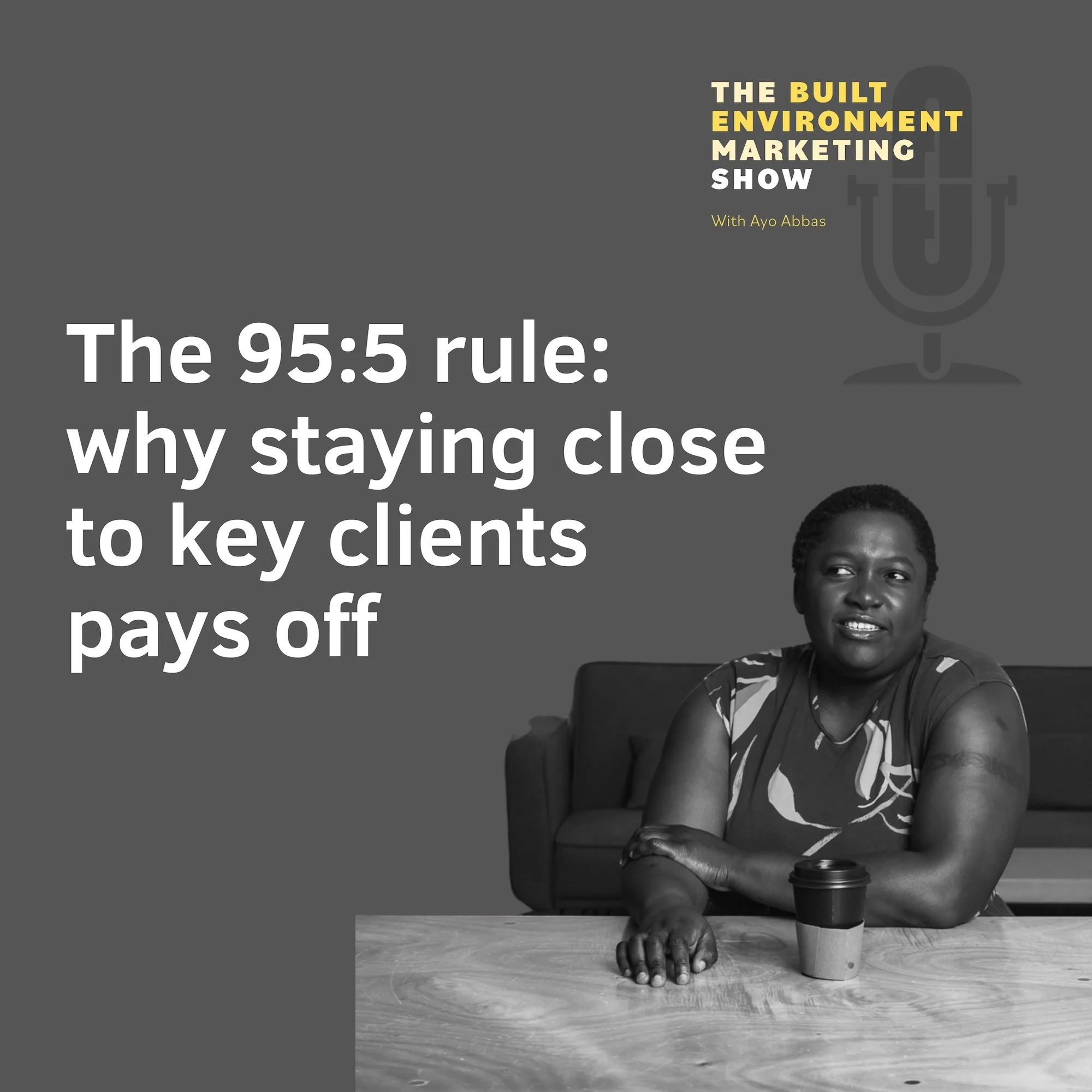
Who is your client? It's the first question I ask almost every leadership team I work with, and the answers are usually categories: developers, the public sector, "we work across sectors". In this solo episode I talk about what being client focused really looks like when it comes to growth.
I share the 95:5 rule from the Ehrenberg-Bass Institute and LinkedIn's B2B Institute and what it means in a sector where projects take years to come forward. I also look back at my time at Mace, where a list of 10 target clients and projects helped grow the infrastructure business from £31m to £61m in three years. Plus following the money, finding where your profit really comes from, and getting marketing, BD and bids working as one engine.
In this episode I cover:
Why "who is your client?" is harder than it sounds
The 95:5 rule and what it means for long lead times and frameworks
Why most firms pour their effort into the 5%
The 10 projects list that grew Mace's infrastructure business from £31m to £61m
Following the money and finding your most profitable clients
Marketing, BD, bids and technical teams working as one engine
Your homework: 10 projects, 10 clients
Links and resources
About the show
The Built Environment Marketing Show is hosted by Ayo Abbas. It is a show that is unashamedly about marketing for architects and engineers, as well as bringing forward voices that we don't always get to hear.
BOOK A CALL TO TALK ABOUT WORKING WITH ME IN 2026
Ways you can support this show
📲 Share about the show on socials
🔗 Follow us on Apple or Spotify
📝 Leave us a review on Apple or Spotify
💬 Tell a friend about the show who you think will benefit.
More podcasts.






Transcript
Ayo Abbas 0:05
Hello and welcome to the latest episode of The Built Environment Marketing Show, hosted by me, Ayo Abbas. And this week it is a solo episode, so I am going to be talking about something that I care about quite a lot, which are clients and growth. I have a feeling that most built environment firms should be more client focused. For me, being client centric and putting clients first is at the heart of marketing, and that's why I wanted to talk about this topic on this episode. So, in this episode, I really want to look at what client focused marketing and activity actually means what it looks like when it comes to growing your business, because in my experience, the firms that live it behave very differently than the firms that just say that they do it. So I wanted to start with a question, and actually, it's a question that I tend to ask almost every one of the leadership teams that I work with, usually right at the start before we even I guess actually get going so I always ask them who is your client sounds pretty simple right but the answers I get are so different depending on who who's in front of me they could say things like the developers or the public sector or we work across residential commercial education. Sometimes I get a long list of kind of big fancy names that are on their website and that kind of stuff. But all of these are true. But really, they're just categories, right? They tell me where you work and much less about who you're really building your business around. So really, I guess I want people to be a bit more granular and really think about the answer to this response. And there's a reason for this because, to me, the firms that I see growing fastest can answer that question very differently. They can tell you precisely the clients that matter most to them, who those people are, and even more importantly, what are the current challenges those clients are facing? What are their pain points? And I think the thing is, when you really, really get into the kind of nuts and bolts of a client, and you really, really understand them, then you know where they want to be in one year, three years, five years time, and also you know what your role is in helping them to get there, which is the most important part. And to me, that is what being client focused is really about. It's about having that granularity and knowledge that you can literally put yourself in their shoes. You are their trusted advisor, and for me, I think that is what a lot of people haven't done that level of work, and that's something that more people should be doing. So today, what I'm going to do is cover four areas, really. So a piece of research that I think is worth knowing about, especially which kind of solidifies this type of approach. I'll share some of kind of my own personal experiences when I've worked in house about what we did at Mace, but also I also want to talk about why being client focus is so important and why it should matter to you, which is basically about following the money. And then I just want to touch on something else that I think is really important, which I guess builds on what I was talking about with the episode that I did a few weeks weeks back with Jeremy Brim, which was very much about marketing and business development and bids working best as one engine, driving towards the same goal with your clients in the middle. And I think that's really, really important. Anyway, so let's get started. So first up, I want to talk about the 95-five rule, which I actually think is one of the most kind of pertinent pieces of recent research about how marketing is now working. It was done by the Ehrenberg Bass Institute with LinkedIn's B2B Institute, and it's really a rule that I think is really worth knowing. And it's a pretty simple idea. Basically, at any one time, only about 5% of your potential clients are ready to buy, and the other 90% will need you at some point, but it's just later, and you don't know when.
Ayo Abbas 4:09
Now, when you think about that, when it and what that means in the built environment, because if anything, in the built environment with our massively long projects, our massively long lead times, you know, it take it take like years and years to get something off the ground, right? So in the built environment, that 95/5 rule means that you might be having to keep someone warm not just for weeks with a like you would if you were a consumer sale, but actually for months or even years. And I think that's what we don't necessarily get our head around because, especially in marketing at the moment, I think there's this huge push towards short termism, performance marketing. Come on, come on, get everyone over the line. But it's like there's also got to be that long term as well, where you're actually looking into the distance, thinking, actually, how can I be supportive to that client now, and just there and and in there. Kind of knowledge for that time when they are actually ready to buy, and I think as a sector we have frameworks that can run for four years. So you know they might not open up again for you know three or four years, but you still need to kind of make sure that you are visible to those potential clients because when they do come up, you want to be there and in their kind of mind as someone that they could be working with, and I think as well the whole kind of public sector budgets, the political cycle, and how all of that works all kind of joined in. It's this huge kind of mess, I guess, this big mess. And I think it's also worth noting that you could go for a coffee with a developer next week, and actually they might not need an engineer or an architect until say 2028, but it's still that relationship that you have to keep warm for that 95% of the time. So it's just thinking about it in that way. So especially as now, as we're kind of coming on to 2027, and let's be honest, the economic outlook isn't looking that great. So I think we've all got to start thinking about, you know how do we kind of prioritise getting close to clients, being helpful to them in even if they're not buying right now, and yeah, just keeping those relationships going, which is why I really wanted to do this episode. I think also when it comes to bids and frameworks and tenders, it's worth knowing that once a tender has dropped and you're not necessarily knowing that client. It's kind of a bit too late. So, here's what I see in so many firms: almost all of the effort goes into the 5%, the live bids, the tenders that have just dropped. Focus, focus, focus. Which, yes, that is very important, but that's where kind of the deadlines are kind of pushing you, and there's that pressure. So, yes, but it also means that you're likely to be kind of neglecting that 95% those people that you actually need to keep warm, and I think that's the part that we all need to get better at those relationships, those long term kind of those long term bets. I guess that's what they are. So just bearing mind that how do you keep them warm is is the big challenge. I'm sure we've all had that feeling, really, when you open a tender and you can tell it was written with someone else in mind, or even in some cases written by someone else for themselves. I've seen that. So the job of marketing and business development is really twofold, is what I'm going to say here. Is that be there for the 5% who are ready now with the right bid at the right time, but also you need to stay front of mind with the 95% who aren't quite ready yet. So when their project does come forward, you're the first name they think of. Can I interrupt you to run something past you? It's actually about our industry. It's the fact that we expect people to know how to do marketing and business development without ever training them properly. A bit like osmosis, I guess. When I was rising up the ranks, you got taken up by directors.
Ayo Abbas 7:45
You sat in the room, you watched how a relationship gets built, and you got the debrief on the way home. It was super valuable. Nobody ever called it training, but actually, that's exactly what it was. But nobody actually noticed when it stopped, and it did stop for two years during COVID. It just couldn't happen, and the people who qualified then fell into that gap and are now moving into management, where winning work is actually now part of their job, an important part of it. I run practical marketing and business development training for people who are good at their job but uncomfortable selling it. What to do before an event, how to start a conversation, how to follow up, also how to do cold outreach. It's all very, very important and an important part to grow your business. If you want to find out more about my training services, head to abbasmarketing.com forward slash training. And I guess this now kind of leads me on to the next section, which is talking about how do you choose which are the 95% to focus on is my next question, and that's where the kind of 10 project story comes in. When I worked at Mace in the infrastructure business, we had 10 projects that we really wanted to win on a kind of long term basis, 10 clients, 10 projects, and we grew that business from 31 million to 61 million in three years, and that was very much about man marking relationships and focusing on those key clients that we really wanted to get to know and we really wanted to work with. And I know that you know working for for firms like Mace is kind of an aspirational thing for many people, but I guess it's a combination of stuff. Was it just the website? Was it just this? It's like no. I think it was having that list and that focus to drive every other piece of marketing and activity for what we did towards those clients. So any marketing plan that I did had to be aligned to those clients, or else it wouldn't be signed off. And I think having that focus and that drive is what really worked, and I think that's why that whole client-focused approach, making sure that the marketing team and the bid team and the business development people are all geared towards those go geared towards those clients and projects, and I think that's really really important. And the other thing that I think you need to think about is what do these clients need from a. Now, so that when those projects do come forward, we're the obvious choice. That one question, when I was at Mace, changed everything about how we worked. It changed the conversations we had. Instead of inviting people to talk about our services, we were meeting them to understand what they were planning and what was worrying them and what was important to them. And we were listening. We were really, really listening, and it changed our content. It changed how we approached them, and it changed everything we did. We wrote about those problems that those clients were going to face now, but also in the future, and just aligning ourselves with them as the people who can be their trusted advisors and solve this stuff. And I think that's kind of what we kind of forget, and I think that's where that client-focused ethos is so so valuable. And actually, it's not just a marketing thing that would permeate into your bids. It would mean that you're a lot more, I guess, I guess, intuitive and in tune with what they actually needed, and you knew what to say. And I think one of the things of the reason this kind of approach works is because you start to be known for something. You start to be known for being supportive. You start for to be known for helping that client, and that I guess is very much about the kind of 95 five rule: is that you're putting your efforts into those people who are really going to help drive your growth and your business forward.
Ayo Abbas 11:18
And now, I guess the other thing I wanted to talk about is about, I guess, being client focused can be a bit soft sounding and a bit wishy washy, you know, listening, caring, great service, you know, all of that kind of buzzwordy stuff. People like, oh, that's not engineering. But the firms that are kind of doing it well are also very commercial about it. So, I think one of my favourite phrases is kind of like follow the money. Like who's funding these programmes? What do they need? What's the driver? Is it funded by DfT but delivered by Network Rail? Actually, mapping out where the money comes from for these different programmes, especially if you're looking at the public sector. Private sector isn't always as clear cut, but actually, I guess you can still also map like funders who are funding certain things for certain developments and things like that, and you can look at what the what your client, that developer, what conditions they're being held to by their funders and things like that, and that can give you a lot of actually this is what's really driving them. So I think it's just I guess being inquisitive and curious. That's what I'm saying, and I think the other thing is you need to kind of look at your actual clients, look at your figures, understand where your actual profits are coming from, rather than necessarily just the revenue. So, kind of actually looking at everything you're doing in that kind of holistic way, and and and really looking at, I guess, where your profits are coming from, but also where the opportunities lie and where you can grow from your existing clients, because I think that whole thing about growing from people you already know and are already working with you much quicker sale to make than actually one where you're focused on getting new clients all the time, which is a lot harder and a lot more longer tail. And I think the other thing to realise is that actually by kind of doing the kind of deep dive into your numbers, most firms actually make their profits from a handful of their clients. And when I ask leadership teams which clients those are, there's often a pause. So I think it's actually worth taking the time to kind of really understand where your revenue is coming from, but also actually which clients are actually making you the profit, because that's really really important as well. And finally, I just wanted to talk about, I guess, marketing, bidding, and bids as one engine. So you know who your clients are, you know where your profits coming from, you've got your list of projects. How do you actually organise around it? And this is the bit where I think we're a bit too fragmented at the moment because in most practices I see marketing is separate from business development, which is set off in bids. They might even report into different leaders. They might even have different P&Ls and all of that kind of stuff. For marketing, looks after brand, the website, socials, bids sits over there in its own team. So I think that whole thing about looking at it together as a cohesive one engine that is all about winning work and working across the piece and making sure that I guess you are setting up your teams for success, so they're there to support the business. And it doesn't matter if you're in marketing, it doesn't matter if you're in bids, it doesn't matter if you're in BD. You are all tasked with doing the same goals and the same objectives for those clients. And I think trying to get that integration and that kind of holistic, systematic approach to marketing is what is really going to make it work, and also give you a lot more bang for your buck. And I think that's really, really important as well. So, like I was saying in this episode, I just kind of in conclusion. I guess what I want to say is that the firms that grow put the client in the middle and get all of that working together. Bids win the 5%. The bits where they're already known, they they how they convert the opportunities that are live right now. Relationships and content look after the 95%.
Ayo Abbas 14:48
They keep you front of mind, so you're known and trusted before the brief appears. And your technical people often are your best business development people. They're the ones clients trust. They're the ones on site in meeting. Solving problems. If they can spot the next opportunity and know who to tell, that's worth more than almost any campaign. But that doesn't mean turning all engineers into salespeople. It means helping them think a bit more commercially, knowing which clients matter most, knowing what to listen out for, and feeling confident to have that next conversation. So yeah, when marketing, business development, bids, and your technical teams are all aligned, working towards the same client list with the same priorities. It starts to feel like one growth engine, and that's when the results really start to move. So bring it all together. Let's think about this. Growth starts with your clients. Only around 5% of them are ready to buy at any one time. So the firms that grow invest in the 95% too. They choose where to focus by starting on the projects they want to win in five years or whatever time frame you want to look for, and by following the money, their own profit, and where their clients will be spending next. And they get marketing, business development bids, and their technical teams working as one engine around those clients. So, you want some stuff to do? Grab a piece of paper or open a blank document and write down the 10 projects you'd love to win in five years' time. Next to each one, write the client. Then write down when someone senior from your firm lasted a proper conversation with them, and that is your starting point doesn't take long. Drop me a line if you want to discuss this a bit more. My email is ayo@abbasmarketing.com. Thank you so much for listening to this show, and I hope you enjoyed it. Take care. Bye. Thanks so much for listening to the Built Environment Marketing Show. Don't forget to check out the show notes, which will have useful links and resources connected to this episode. You can find that on abbasmarketing.com. And of course, if you like the show, please do share it with others on social, as it helps more people to find us. See
Unknown Speaker 16:57
you soon.
Transcribed by https://otter.ai