WR-AP Retrofit: why an architecture practice launched a retrofit spinoff with Max Rengifo
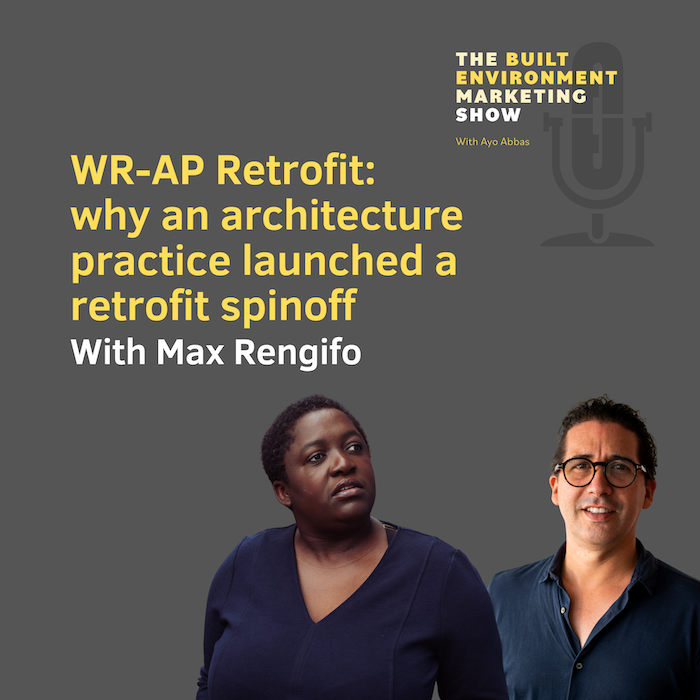
Decarbonisation and retrofit are two of the biggest challenges the built environment industry faces. In this episode, Ayo talks to Max Rengifo, Director of WR-AP Architects and its new spin-off, WR-AP Retrofit, about how a service that started as an aspect of everyday projects became a business in its own right. And what it will actually take to retrofit the UK’s housing stock at the scale the Government is committed to.
In this episode we cover:
How retrofit went from being a byproduct of Wrap's projects to its own business, WR-AP Retrofit
Why Max and Sean put their idea in front of Kingston University’s MBA students, and the 300 page report it produced
The three main reasons behind splitting into two separate brands
What it takes to get properly accredited in retrofit
Why the UK needs to retrofit one home every 53 minutes to hit government targets
Why talking about moisture and steamed up kitchens works better than acronyms
Max's advice for practices considering more retrofit work
Resources & Links
Kingston University - Help to Grow
Download my 101 events and conf ideas downloads
I've created an amazing free resource about what to do before, during and after events so you can get more ROI and visibility. Get your copy here
About the show
The Built Environment Marketing Show is hosted by Ayo Abbas. It is a show that is unashamedly about marketing for architects and engineers, as well as bringing forward voices that we don't always get to hear.
BOOK A CALL TO TALK ABOUT WORKING WITH ME IN 2026
Ways you can support this show
📲 Share about the show on socials
🔗 Follow us on Apple or Spotify
📝 Leave us a review on Apple or Spotify
💬 Tell a friend about the show who you think will benefit.
More podcasts.









Transcript
Ayo Abbas 0:05
Hello and welcome to The Built Environment Marketing Show, hosted by me, Ayo Abbas. You can find out more about me and my work at Abbasmarketing.com. Decarbonisation, retrofit, and us reaching net zero is a big challenge that both the industry and the wider society and world need to face. And with our increasingly rapid climate collapse, the weather extremes we're now facing are becoming the norm. And the importance that built environment firms can play helping to alleviate all of this is really, really vital. Anyway, when I saw a post on LinkedIn about rap architecture setting up a spin-off practice called WR-AP Retrofit. I just had to get them on the show, so let's get on and listen to my interview with Max Rengifo. Enjoy. Hi, Max. Thank you so much for coming onto the show. Can you introduce yourself and what you do at WR-AP and WR-AP Retrofit,
Max Rengifo 1:02
yeah, sure. Thank you for having me today. My name is Max Rengifo. I'm a director of both WR-AP Architects and WR-AP Retrofit. And yes, we've been going for some time. I guess we're going to talk about that later. Yeah, that's me.
Ayo Abbas 1:20
So, how did you and Sean, Sean Weston, who we're talking about? How did you end up working together, and what led you to set up WR-AP Architecture?
Max Rengifo 1:27
Right. So, Sean and I met 22 years ago when we were in a big practice in Central London, and since then we've been kind of following each other and another another bunch of practices. And about eight years ago, seven years ago, we decided it was probably time for us to come together. So we shared boards. We sat at the directorship in in another practice, and we we we thought our complementary skills were good. We want we we both have kind of the same age, young family or not young anymore. It was young back back then. Yes, we wanted to have a kind of a different focus, or wanted to do, and yes, that's how rap started. Was quite organic, to be fair, but yes, that's how we we start. So we know each other very well, and we're complementary. That's that's the main. That's your
Ayo Abbas 2:31
main thing. That's the main
Max Rengifo 2:32
thing. Yes.
Ayo Abbas 2:33
And so I guess the reason I kind of wanted you to come onto the show was because I read your on your website recently. You put up a kind of, I guess I'm calling your statement of intent, but that kind of clearer direction for rap piece, which I thought was a kind of summary of where you're taking the practice, which I thought was really, really good. What kind of led you to do such an initiative? I guess.
Max Rengifo 2:55
So you're talking about the the LinkedIn. Yeah, I
Ayo Abbas 2:59
actually was on your website. Actually, I saw that's the thing I saw. So I saw that you'd launched WR-AP Retrofit, and then that took me to go and dig into your website where I found that.
Max Rengifo 3:09
Okay, so as I said, we we've been going for WR-AP for about seven and a half years, and we've been doing different type of projects from education, residential, civic buildings, housing. So we have kind of a not one sector practice; we are multi-sector practice. But inevitably, in all of them, we've been doing a lot of refurbishment and retrofit. And we thought in the last probably couple of years we started doubling with the idea to offer that service of retrofitting, and obviously it's it's also it's a classical after five years in practice you go to okay this what we've done it's been tough for different different reasons, and everybody's on the same boat. We said, okay, what's the next step? What do we do in order to move WR-AP forward? And obviously, we looked at things like our location. We looked at our client base, our sectors, and obviously, you look at the services, and the the the thing that always came back all the time was kind of we do a lot of refurbishment, we do a lot of retrofitting, but it's almost like a byproduct of the projects as opposed to the focus of the projects, and we we really thought, okay, would it be a good proposition to start to do retrofitting? And so we started to investigate ourselves about the retrofitting market. And WR-AP stays as WR-AP Architects. We've been doing what we've been doing, which is great. But more and more, the more you investigate, you realise that this is a. Every specific service is a very technical one, and is actually in high demand, and also requires a kind of different mindset from the from the kind of pure architectural projects, especially with the new initiatives with the with the government and the funding from the government and probably funding for funds and the private sector start to see the benefits in investing in that sort of projects, especially in housing, and that's something we were already in WR-AP doing. We are great believers on green buildings and sustainability. So how do we actually formalise this? That's how WR-AP starts to form as an idea in our heads, and then we we started to investigate more with the help of others third parties.
Ayo Abbas 5:53
Fantastic! And you did a you did you did a research an MBA research project, didn't you, with Kingston University? Can you just tell us a bit more about that.
Max Rengifo 6:01
Yes, well, as a result of these two board meetings, where we discuss first the first retrofit service, so we went off and started talks of people that were doing it, other architects, contractors, people that we know, people that we know, and we realised, okay, this is not necessarily a we're gonna do now museums or residential. Or this is a very different. We need to we need to train ourselves to do it, and and we saw the level of investment both in times and and money, real money that we needed to go to in order to offer the service. So we came up. We came up this management consultancy programme that the Kingston University do, and it's basically the last the last year students the dissertation the last year project their thesis is to open it up to the to the public, so you can go and pitch to them your idea, and see whether they can work with you. So you have all sort of companies saying we want to expand, or a startup saying I got this idea, how can I get it to out there? And then what we said to them is, we are this practice, and we want to start this retrofit service. First, it's business why it doesn't make sense. Second, how do we do it? Why the different ways that we can do it? And third, what's the not only the way that we can do it? How that kind of amalgamate a rap, right? Is it going to be competing with rap? Is it going to be supplementary to rap? And it was fantastic. We never done that before. We never done that before, and that came actually as a result of Sean did a couple of years ago a mini MBA with help with the help to grow programme. Yes,
Ayo Abbas 8:00
I've heard of that. Yeah, and that's at Kingston, isn't it? That's one of the most popular ones.
Max Rengifo 8:04
It's one of our popular ones in London, but it's national wide, so you can you can do it everywhere. There are some universities that subscribe to that programme, and it's 90% subsidised by the government, so you pay only 10%
Ayo Abbas 8:19
And its practice is, I think, over five people, isn't it, or something like that?
Speaker 1 8:22
No, it's SMEs, SMEs. I've always known it's
Ayo Abbas 8:25
more. I thought it's no smaller than five.
Max Rengifo 8:27
To be fair, it's changing. It's changing all the time, right? But in any case, the the the the good thing about it is that we got into that kind of business mindset about two or three years ago, and being in contact with the business school in Kingston, it's been great. So we went there, pitched our idea, and then the students select the ideas that they want to work. And four of them, really really bright guys, took the the challenge, and none of them had any background with construction, with construction industry, nothing, and they send themselves themselves a very tough learning curve for us to understand the sector, which I presume that's what a business consultant does for any business, right? You don't understand the business, and then they interview our staff, they interview our clients, they interview people that don't even that we don't know, but we we know that they were very good in the retrofit market, engineers and and contract and construction contractors. Sorry, and it was really good. So the feedback was really good. Then they presented to us, and and that is a is about 300 page report with everything we need to do. Obviously, there were assumptions there that probably were not absolutely. Rise, but it gives us a very solid framework upon which we could actually act and say, okay, these are the next steps, and we use that document to start to form our business plan. So we form a business plan, and then we form with our accountants and the people that help us at WR-AP, you know, accounts and the money, we start to to frame this into a structure, and then we decided to do it under another company related to WR-AP, but it's not WR-AP, and that was partly, I would say that there were three things or three heads in here. One was the business school said to us, "This is a very good way to have a very specific targeted service market, so people don't delude when when you go to your website and see a I don't know a church or a school, then they said, "Ah, this and other guys. Second, in terms of money, from from our accountants, they thought actually it's really good to have it separately because then you can actually get funding. You can actually invite partners, even if if things go well, which basically will be, buy or or team up or do joint ventures with others. That that would be that. That's that's the idea of that. And the third head, it was Sean and I thinking we'd rather be seen as an specialist on that specific, very, very specific market than architects trying to be opportunistic, if that makes sense, and and so I decided. So we we decided between the two of us. Sean is stays with WR-AP Architects. Obviously, I'm still in rather architects working with with architecture, and Sean will be working in retrofit. But I will lead in the retrofit. WR-AP Retrofit.
Ayo Abbas 12:03
Is there also was there also a kind of risk element as well by like splitting the two, or not as much as that? Was that not factored in?
Max Rengifo 12:10
Actually, so we funny you said that. We always saw it as a more risky to have it separate.
Ayo Abbas 12:20
Really, I thought it would be the way around.
Max Rengifo 12:22
Yeah, because if you do, if you do,WR-AP Architect for seven and a half years, right? So we can actually, how do you say, fill the gaps that WR-AP Retrofit in the beginning would not have will work if it makes sense, But having a separate entity, this this stand is a standalone entity, right? Although we are we are sharing some resources, obviously the the office and the and the studio and everything. It is it is I think it's riskier to have it to have it together. And let's say if you start together, it's almost like a solid ground. You know, people see Sean and Max together. You know, some people ask me, but are you still, are you still together? So yeah, yeah.
Ayo Abbas 13:12
Have you broken up? Exactly, exactly. So you
Max Rengifo 13:15
need to, you need to, you need to explain a little bit so that it's a new venture. This is a a new service.
Ayo Abbas 13:20
Yeah, yeah. No, yeah. I thought I thought the risk, and we'd be the other way round. But I guess because there's such big scheme, there's such big schemes in people's homes and all of that kind of stuff. I wasn't sure if there was like more in more of an insurance thing and stuff like that. But yeah,
Max Rengifo 13:35
in all fairness, one of the things that the that the we said at the beginning, if we're going to do that seriously. So I try myself as a. I did again going back to school, like a long course by the Retrofit Academy, which for retrofit designer, and I'm doing other courses as as we go. Dan, one of our technical guys here is done the retrofit coordinator. Chelsea's done the retrofit assessor. So we are all now accredited to do what we need to do. We have we have the endorsement of obviously being an architectural practice, which takes me to another point, which is probably softer, less less marketing or business driven. But it's the fact that there is a lot of retrofit designers and coordinators and assessors out there. They come from different worlds. They come from engineering. They come from surveying, which is fine. It's great, but certain projects require requires a little bit of an architect head, especially when you have 222 things that we complement very well with WR-AP Architects, which is planning. Some of the retrofit projects require planning, so we can do planning. We we know how to do it very well, and second. Engagement, which is the soft side of the retrofits, which we've been doing for years, working in schools with youth centres, civic centres, working with communities and regeneration projects. So we know how to approach a huge community inevitably, whether it's a regeneration, housing, or retrofit, there will always be some, you know, resistance to change, and and how you deal with that in a in a nice way, you you know you bring them forwards and you explain in a nice way. So I think that is something that we bring to to our service that is kind of unique. Being architects, coming from architects.
Ayo Abbas 15:42
Hi, it's Ayo here. If you've got an event coming up, do check out my guide called 101 Ways to Get the Most Out of Events. It's before, during, and after the whole shebang. It's a fantastic resource, and don't just take my word for it. I got a text out of the blue from one of my friends this week saying, "Your How to get the most out of events doc is amazing. It's filling in gaps in my own plan of attack process, so thank you for sharing stuff like this. So it's not just my words saying that; it's hers. If you want to get your mitts on it, it's free and full of practical stuff you can actually use. There's a link in the show notes to get it, or head to abbasmarketing.com/events. Now back to the show. And having two separate brands has that kind of changed how you market both brands themselves, or is it more of the same? Have you done something different with WR-AP Retrofit?
Max Rengifo 16:31
We've done something different, but we we recognise that people know us as WR-AP . Also, the name WR-AP works very well with retrofit,
Ayo Abbas 16:42
of course.
Max Rengifo 16:43
With WR-AP, yes, with WR-AP. So we said, okay, we don't we don't want to lose that. Second, second is how people know us. So we did a little bit of changing the logo, and the logo for WR-AP is called as a very interesting play of with the so it's Weston which is shown so the company is Weston Rengifo for Architects Practice that's
Ayo Abbas 17:07
oh I never knew that
Max Rengifo 17:08
yes that that that's that's that that is the that is the how it's called the limited company kind of but we trade and we have a trade logo trademark and everything called WR-AP, and the idea that the idea of that was is Weston relief for architects practice day one. In the future, could be Weston relief for and people.
Speaker 1 17:33
Ah,
Max Rengifo 17:33
and so and that's why there is a hyphen between the W and R, and A and A and the P. There is a hyphen, right?
Ayo Abbas 17:41
A lot of thought gone into that. That's really
Max Rengifo 17:44
a lot of thought, and that was day one. To be fair, that was day one, and and the the when we set up retrofits, we we we call it Weston Rengifo for Retrofit, Weston Rengifo for a Retrofit, but the trademark is Retrofit.
Ayo Abbas 18:07
Ah, okay, yeah.
Max Rengifo 18:09
So, and and and the whole idea, and and it's got the same font, it's got the same thing, but different colours. We went obviously for for something more green, more more related to to what we're doing, a different website, totally different website. But sometimes we go and we talk to people, and they said, "Well, we need both the architects and we need retrofits. So we can do both. We can do. We can. We're not going to compete to each other. Actually,
Ayo Abbas 18:40
like thank them. Thanks for rejection. Exactly. Don't tell
Max Rengifo 18:43
him. Don't tell him. So that's how we've been doing it, and we have two LinkedIn pages, and we have blogs going out often,
Ayo Abbas 18:54
pretty regularly,
Max Rengifo 18:55
pretty regularly. Yeah. So we, what we do is we take a theme, both in drop and grab and grab retrofits, and we think okay, very simple, very quick things that actually we we discuss here on Monday mornings or over a coffee. That's a good point. Let's put something out there for that, and that's how we've been doing it. There is no conflict between the two, which is fantastic, and because the audience for WR-AP Retrofit will be a completely, hopefully, a new one from rap,
Speaker 1 19:33
I presume there is not going to be any any particular conflict there. Like,
Ayo Abbas 19:39
so how? I mean, you launched that retrofit at UKREiiF, right? Is that correct? Or you kind of I saw that's where I saw you.
Max Rengifo 19:46
That's when you saw us. That was when
Ayo Abbas 19:49
you officially launched. To be fair,
Max Rengifo 19:50
it was three weeks, two weeks before. So yes. Oh, okay. Yes, you can say yes.
Speaker 1 19:55
Yes, because
Max Rengifo 19:56
we we hold we hold the the link. An announcement just before the that
Ayo Abbas 20:03
makes sense because there's a lot of traffic around there. And how has it been received? What have clients said? What have what have what have people said? Does it make sense to people? Are they positive? Are you getting that? I guess that new practice vibe. You know that thing when everyone kind of comes towards you because you're new.
Max Rengifo 20:18
Yes, it's kind of interesting because you have people that don't know us, and so who are you? Where you coming from? And so you need to start from you know we we know each other a lot, so you tell the whole story. Whereas other people send us you know messages and say this is brilliant. What is it? Tell me more. Love to be involved, you know, engineers, friends of ours, and and and consultants. The other day, I having I was having lunch with a with a really good friend. He's a sustainably sustainability engineer, and and he said, "Wow, you just-it's so clever the way you did it because there is no conflict. I see, I see why you've done it. I say why you trained yourself and why you, instead of trying to buy the expertise someone else, it comes sort of within the practice, but at the same time there in their own in their own place, is and I'm listening to these things. It's really refreshing. Having said all that, the the challenge now is that people there are big players out there. As always, there is a big competition. People that are doing it is is is just to get the traction. So we are starting with two initial projects with one that is big with a with a local authority and the other one that is small. But testing, you know, testing our our methodology is is that is that something that gets actually staff excited? Which which to be fair, the internal when we launched it here internally, which was probably six months or eight months before, when when the business Kingston University got involved, I said, okay, some people are going to interview you guys. This is what we're trying to do, right? The reaction here was amazing. Really positive, super positive. Which we were actually quite surprised and gladly surprised that that and they said, "Put your hands up. I want to be part of it. I can I get can I get my name and for the next course available. Available.
Ayo Abbas 22:43
Amazing.
Max Rengifo 22:44
And I thought, wow, this is really good
Ayo Abbas 22:46
because it's very, very different than a traditional architecture work, isn't it?
Max Rengifo 22:49
Correct. And it's not, you know, if you think about architects, the the stigma is you do a lot of Photoshop and images and and da da da. I think the reason why Sean and I got together is because we've been doing you know the dirty images and things, but we like to see things being built, so we do everything and we manage teams and we do everything, and that's what we're trying to do here in the practice as well. So we get really young part ones and part twos and get them to site and solve problems on site and and mentoring them, it tells us that the people around the table are the right people. It tells me that they they understand that it's not Photoshop and 3D renders and all the time, and and that there is and actually the objective at the end, the kind of the ethos of practice is actually underpinned by this rug retrofits. It was only natural to do it, and to do it seriously rather than another service where you put, yeah, we do education, commercial, residential. No, no, no. This is serious, and it's going to have their own identity. That's that was quite. I was
Speaker 1 24:00
more. There's a lot of satisfaction to to hear that from the from our our team in terms. Because it's
Ayo Abbas 24:09
a lot more technical, isn't it? And the work you have to do for a retrofit, because it's like big big funding kind of streams to kind of do this work, isn't it? Can you kind of talk through what's involved a bit? Because I'm not everyone's going to know, I guess.
Max Rengifo 24:19
Yes. So there is a big well. There's been a lot of funding around retrofit. Retrofit is effectively something that tries to do a few things. Obviously, is targeting housing, social housing. So basically, the two main providers of social housing are local authorities and housing associations. They can apply to get funding from the government, and the funding relates to certain measures. I it could be insulation, it could be lately, be more about electric electrification of of a system of heating systems, so decarbonisation. Get rid of gas. So there is a big debate whether one is before the other, but you know that that's a different matter. But in essence, they apply for it. the The way they apply for it is they go to the government and say, very simplistic, right? Perfect, big terms. We got I don't know, we got 20,000 homes. We're going to plan to do it in the next 10 years, and and the first trench of funding be to use to it will be used for these particular homes. So for that, you need to do an assessment. So a retrofit assessment. Go assess or go with the with the coordinator and said, okay, this is what you need to do. You get the funding. Then you implement the project. You design the project, and then certified and approved contractors. This is the new part that is is very interesting. In the previous scheme, funding schemes, there was a there was a a link broken between the the the procurement and the design, and then the actually delivery. No one was seeing what these guys were doing. That the the these told these told us,
Ayo Abbas 26:11
which means that you're leaving yourself really wide open to having bad work, right? And
Max Rengifo 26:15
and and then the funding got really really bad reputation as a result, which in my opinion, was not necessarily the funding. It's a methodology, and how the funding was given, and that is being addressed with the new pass. I'm not going to talk with with an Ayo. With the new standards that are out there, the new standards are out there requires both so assessors, architects, and assessors, coordinators, and designers to be fully tantrumed with the installers, and the coordinator goes from day one all the way to the end to make sure that that happens, and and after that there is a monitoring role as well.
Ayo Abbas 27:00
So it's a much more full cycle role rather than just doing the front end because you're overseeing what happens in terms of the overall installation and improvements, right? Which makes a lot more sense, right?
Max Rengifo 27:10
Totally. And you need to upload your photographs of the installed equipment or the installed measure, and then you need to put it out there, and it's it's completely transparent. People can go and see it. Then you go after after it's been in place and monitoring and monitor that. And there is there are now requirements in place, and that's all the the courses that we've been doing. How do we work together, right? So it's a coordinated. I would say it's a coordinated funding stream, which hopefully will tackle. It's going to be more difficult. It's going to be there is a lot of learning curves out there. The funding is not coming as quick as people would like to, but we believe that at the moment this starts to be a kind of business as usual in good terms, in in in terms of a high, highly standard, controlled process, this is going to change. It's going to change, and and we need to we need to do millions of these houses in the UK. There are particular stats that say you need to do one every 53 minutes.
Ayo Abbas 28:23
You can get quite busy
Max Rengifo 28:26
then, in order to hit in order to hit the the target, the government target. So, but taking that aside, I think it's the right thing to do. The UK has got one of the worst housing stocks in Europe. As well, we we now experience the overheating, but as we know, these extremes are going to get even worse, and we need to we need to come up with a strategy as
Ayo Abbas 28:53
a. And do you think that retrofit overall as a concept has a bad image problem? Do you think people don't necessarily know what it is, or know why. I guess they should be doing it because it's not always, I guess, the most glamorous work for an architect, is it?
Max Rengifo 29:07
No, it's not, and and it's been related. It's it's it's as always. It's got different different things. One bad reputation is the where we just talked about.
Ayo Abbas 29:18
Yeah, the installations
Max Rengifo 29:20
failure in the past, similar to what when you talk about prefabrication, people think about oh, prefabrication 60s, terrible blocks and you know, and accidents and things and asbestos and all of that. Prefabrication as such is great if you do it well, right? So retrofit is called the same kind of bad reputation. Second, I think it's been landed in the wrong way. That's why we believe the the engagement piece that we we we are developing is is quite important. So you talk to people with the language. So instead of saying we're going to do a airsource heat pump. Or MVHR, or we're going to do EWI. So people say, "What are you talking about? You you need to go there and talk to them in a very very simple way. Explain what moisture means. Explain that you breathe, that you cook when you cook pasta, and then you add all the steams. That needs to go somewhere, and hope. And normally, what happens is he stays in your in your home, right? And because it's cold and terrible, you close the windows and and you breathe in your own vicious air. All these things you need to explain it in a nice way. But ultimately, as you know, we're human beings, right? So you go home. The last thing you want to do when you go home is to see contractors drilling into your walls. You having to pack everything that you got in your loft in two days' time because the contractor never told you it's going to be in two days' time, and you have you know all your life in the loft as we all do. We all have stuff that we never use, but we have them, and we. Yeah, I've never
Ayo Abbas 31:02
actually gone in my loft. Nobody
Max Rengifo 31:04
does that. Believe me,
Ayo Abbas 31:06
I boy, I was like, I don't really want to see it. I think I've lived there for 11 years. Correct, but
Max Rengifo 31:11
but but I bet you you are really fond of what you have out there, you know. And you might remember probably seven objects out there. I
Ayo Abbas 31:17
put nothing up there. I've literally never gone.
Max Rengifo 31:20
And you never gone there. Okay, okay. Well, you're one of the few because when you go to these houses and you see the amount of stuff, right? And I'm I'm I'm I'm I'm cool. I've got a lot full of stuff. This is solid, though, but it's full of stuff. It's full of stuff. So all of those things creates a very very tough environment. So you go into the very heavy environment when you talk about it. And the word retrofit is got is not doesn't have a really nice sound. It doesn't have a very romantic, you know. Because
Ayo Abbas 31:58
no one's going to know what it means. It sounds old, like retro when you think of it, right?
Max Rengifo 32:02
Yeah, well, it's it's like going back and do something that should have been happened in the first place. So and feed is a fit feed for purpose. Fit make your home going back and and and remake it so it can be fit for purpose. And what you need to be doing there, which is live and do nice things. So I think etymologically speaking, the word is perfect. Sound or you know
Ayo Abbas 32:32
standing, desirability. It doesn't sound like a word. Yeah, oh yeah, I really want that done to my house. But I guess if you talk about actually, we can have better installation. You can have less bills. You can have like the things that retrofit will bring to you. People are more interested in that. Correct.
Max Rengifo 32:47
So you need to tell them, and that, and this is the this is the the conundrum that we're living on. It's like okay, poverty, energy poverty is massive, right? So people don't cook and they eat out not very good food because they cannot afford to switch on the oven. Very simple, and you know when you hear about those things, you're thinking, "Wow, okay, this is this is not good. You have elderly people switching on two hours the heating in winter because they cannot afford to have it switch on the whole day, and the house is leaky, so it's two hours, and then an hour and a half later is cold again, right? So, how do we tackle that? And I've been using this for years: the analogy of going out. When you go out, you dress for the occasion. So if you're gonna go for a hike in the winter, you put a jacket on it, right? But you don't go in shorts. You you probably have also very good shoes, a very good socks, and very good trousers, and and so you you do it, right? But if it's raining and it's hot. You don't put a plastic bag on top because if you put a plastic bag on top, basically what happens is you start sweat. You need to have something that breathes with with with your with your moisture. So, having a good jacket or a good raincoat also relies on having a good zipper, so it's not leaky, and you don't have that kind of that little, you know, draft that goes behind your back that is making you. Oh my god! She thought about this a lot. Like this is a
Ayo Abbas 34:31
lot of detail. No, this is no. This is this
Max Rengifo 34:35
is a way to communicate, and this is the true is the true biographical suffering of some from South America coming to UK. I like this the level of detail that have ever done this. Yeah, so I I I I've been thinking about like you know shoes and you change shoes in Venezuela. You use the same shoes from in January until December. Use the same same clothes. There's no change, right? I mean, the only thing you can carry is an umbrella or not. That's it. But is is is this thing about physics and and that is very abstract to to to to communicate and how you communicate that with a word as difficult as rest of it, or sustainability or environmentally friendly, or all these kind of buzzwords that basically people don't mean anything. So when you talk to people about a healthy environment, you have a healthy home, you're going to breathe good air, good quality air. The people understand. Sorry, but we're talking about heat. I said no, no, no, no. Heat, heating is one of the things. But as I said before, if you are able to have good ventilation and keep
Ayo Abbas 35:50
everything exactly,
Max Rengifo 35:51
and keep and keep keep you warm with good ventilation, we've done it. And that that's the ultimate goal: being healthy, healthy environments for everybody, and. and I suppose it sounds very basic, but it is very basic what we do.
Ayo Abbas 36:09
That's what we're trying for is, though, isn't it? It is very basic. The standard, yeah,
Max Rengifo 36:12
yeah, but it's very basic. But at the same time, it's very difficult to communicate. It's very difficult to basically expensive, and yeah, it's it's well done
Ayo Abbas 36:24
for taking on the challenge. That's for sure. Yeah, yeah. It's not easy. Even just you think because it's it is a technical thing, a very technical thing, and it's dependent on each house is going to be different as well, right? It's not necessarily all the same.
Max Rengifo 36:37
Yeah, that that's the beauty of retrain when you see architecture from that specific perspective, and you understand there are things like archetypes. Archetypes are the different type of homes that you can see in a one street. So you have, you know, Victorians, and you have post war, and you have, you know, 1980s, and you have all of them
Ayo Abbas 37:02
just there,
Max Rengifo 37:03
and they're there, and they're there, and they are part of the same estate. And then, and then on top of that, you have this one is these seven in the terrace of Victorians are council council homes, three are lease halls, and four are you know housing association. How do you how how do you put all these people at the same? Is is is is fascinating. To be fair, the challenge is fascinating. Very different to architecture. I am I am exploring my my a different part of me. To be fair, which is more, is very human, you know, very, very human, very, you know, you care about these things, but at the same time, as you said, very technical.
Ayo Abbas 37:49
Yeah, and I guess it's my final question. I mean, what advice would you give to a practice that's considering doing more in the kind of retrofit space? What have you learned that you think would be useful to
Max Rengifo 38:01
them. Care a little bit more. I think. Well, that two things. I always, I always have two or three answers for everything, as you can see. But one is, architecture is not all about design aesthetics and and and and having a cool, perfect project done. I think as a as building industry professionals, I think we are we should be able to help and contribute to the biggest challenges out there. And one of the biggest challenges out there is not doing beautiful business only; is to actually making homes Healthy and environmentally adaptable for people living there, especially people with with the difficulties or disadvantages. Now, that that's that's that's the the the side of care a little bit more. And second, business wise, it does make sense to have that side of you. Even if you don't want to go like we did a separate business and we're gonna do we want to do big retrofit. If you want to do small retrofit, there is a need out there. Real, we are we are we are now. Tomorrow is going to be 35 or 36 degrees. I bet you in winter it's going to go minus minus two, minus three, minus four. Some drinks. There are more strips. We need. We and there is. It only takes a little bit of a conflict somewhere around the world for fuel to just go nuts, right? So we cannot be dependent on that. We need to actually put our good coat, good good raincoat, everything.
Ayo Abbas 39:50
Our socks. Yeah, exactly. Yeah, and and and
Max Rengifo 39:54
and don't rely on on on hot drinks and bananas to be to no. Do a little bit of both, yeah. So, I think is is is the the the care a little bit more architecture can give loads there, and there is another another side of things which is the business side. You can actually balance your your your books by having repetitive work because this is actually actually the other thing is very repetitive, very mechanical.
Ayo Abbas 40:22
Once it gets going, once you've got your process agreed, yeah.
Max Rengifo 40:25
All right. So you have typical details, and you have obviously every every job will be different, but the majority of it is is different, and and there is no committee saying ah no, we would like to see it ping rather than no. It it basically the measure is insulation, is MVHR, and is heat pumps in the next seven years, and this is how we're going to implement it. It's very, very technical, if unfactoral, which makes it really efficient, or should be efficient.
Ayo Abbas 40:59
You're getting there. You're getting there. Efficiency is developed. Anyway, I just want to say thank you so much for coming onto the show. I've really enjoyed the conversation.
Max Rengifo 41:07
Thank you for having me.
Ayo Abbas 41:09
And how can people find you?
Max Rengifo 41:10
Well, you can go to www WR-AP-retrofit.com.
Ayo Abbas 41:17
Thanks so much, Matt.
Max Rengifo 41:18
Thank you very much. All the best.
Ayo Abbas 41:22
Thanks so much for listening to The Built Environment Marketing Show. Don't forget to check out the show notes, which will have useful links and resources connected to this episode. You can find that on AbbasMarketing.com. And of course, if you like the show, please do share it with others on social, as it helps more people to find us. See
Unknown Speaker 41:41
you soon.
Transcribed by https://otter.ai