101 episodes in: my honest reflections on built environment marketing
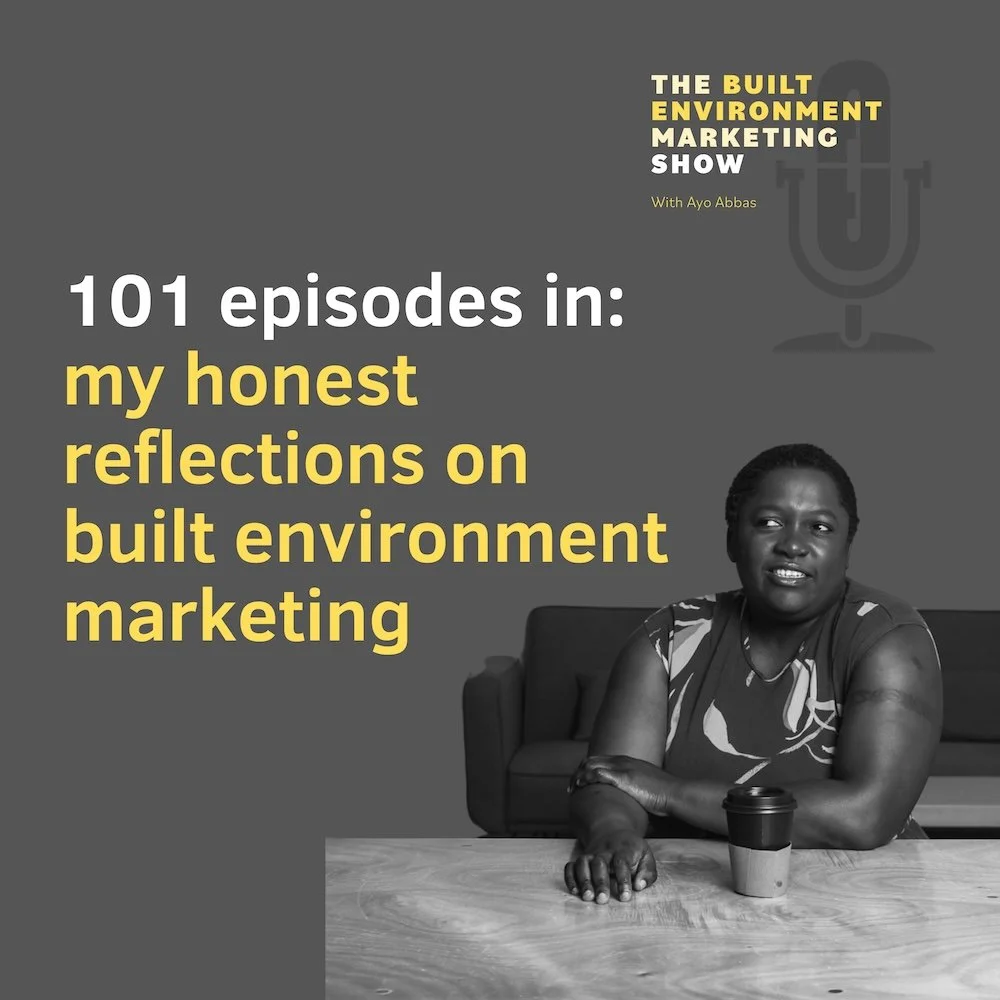
Episode 101 of The Built Environment Marketing Show is a solo milestone, a chance to reflect, celebrate and take stock of six years of conversations about marketing in one of the most complex, overlooked sectors in business.
Ayo Abbas shares what 101 episodes, 20,000+ downloads and 70+ guests have taught her about the state of built environment marketing in 2026, and what separates the firms who are winning from those watching their pipelines dry up.
She covers four defining themes:
the real role of AI in your marketing toolkit
why brand has finally overtaken portfolio as the key differentiator
the industry's persistent failure to value marketing talent
what the LinkedIn algorithm shift actually means for how you show up.
This one's for anyone who's ever had to justify a marketing budget, fight for headcount, or convince a partner that the work doesn't just speak for itself.
Resources
DOWNLOAD - 101 practical ideas to get more from events checklist
Barbour ABI - The Case for Marketing Investment in the Built Environment
Previous episode links
Mace with Danielle Regan and Dave Hendy Episode 23 Part 1 and Part II
Rachel Bell and Rob Sargent, Stride Treglown- Episode 1
Tristram Carfrae - Arup Episode 47
About the show
The Built Environment Marketing Show is hosted by marketing consultant and content creator Ayo Abbas from Abbas Marketing. It is a show that is unashamedly about marketing for architects and engineers, as well as bringing forward voices that we don't always get to hear.
BOOK A CALL TO TALK ABOUT WORKING WITH ME IN 2026
Ways you can support this show
📲 Share about the show on socials
🔗 Follow us on Apple or Spotify
📝 Leave us a review on Apple or Spotify
💬 Tell a friend about the show who you think will benefit.
More podcasts.







Transcript
Ayo Abbas 00:05
Ayo. Hello and welcome to episode 101 of the built environment Marketing Show. Yes, the show is still hosted by me, Ayo Abbas, and I love doing it. You can, of course, find out more about me and my work at Abbas marketing.com, and no, I didn't quite get around to this episode being the 100th episode, which you'd expect, because I wanted to put out the UK reef episode and I wanted it to be timely and topical, so I ran that before this one. So anyway, we are going to kind of celebrate, reflect on the 100th episode for the show, and then I will talk through kind of some of the themes, some of the stats and some of my guests, and some of the stuff I've loved about the show. And yeah, it's that kind of celebratory episode. So hopefully you can join me. Hopefully you've listened to the podcast for quite a while, but yeah, that's what's going on. So this show was originally called marketing in times of crisis. It was launched on July the third 2020, we were three months into lockdown, and I did the podcast, mainly because I'd really got into podcasts when I had my son, and I started listening to them avidly, and then obviously we had lockdown, so I learned how to podcast. So I went on loads of webinars, did all that kind of stuff, learned how to podcast. And then I thought, I'm going to launch the build, launch my own one, which wanted to be about marketing in the built environment. Basically, I set it up around then in lockdown one, because I wanted to show what good marketing looked like. But I also wanted more firms to kind of be doing good marketing, so that they could ride out the covid crisis, particularly as people were going online and digital and had no choice. So that's really what I wanted to showcase. So now we're six years into the show, which is almost fantastic, which is basically fantastic. We've had over 20,000 downloads, which isn't huge, but for a niche podcast, it's pretty good, to be honest, I'm happy with that, and over 70 guests. So now I kind of do a mix of solo episode one week, and then I have a gap of at least a week, and then I will do an interview episode, because, to be honest, it's easier to manage when I record an episode alone, rather than having to set up an interview with a guest and all that kind of stuff. So I kind of alternate which I find a lot more, I guess, manageable, which is important when you're running a podcast. I think the main one of the things about podcasting is that one episode, it probably takes one long day to do the write the script or find the guest, do the questions, do the briefings, all of that kind of stuff, putting it together, doing all the kind of admin afterwards. So you're looking at one long day when it comes to getting out a whole podcast episode. So, you know, twice a month, that's two days of time. So yeah, that's kind of how I run the podcast myself, and then I record it over here in my home office, at home in tooting. And yeah, that's what I've done, really. I use a road podcast mic, and then I also have some headphones, and I just did my laptop. So yeah, that is how I record the show. But anyway, like we said, so I've had over 20,000 downloads and 70 guests. My top episode still is episode number six, which is Smart Cities branding and digital, which was with Rick Robinson from Jacobs, where we had, I think, about 860 or so downloads, which is great. And that show is that episode is still being listened to. I think it actually did better before I switched podcast hosts. There must be a missing 404, somewhere out there in the wild that is probably taking more downloads. My next most listen to episode was actually the episode with Magnus Strom from Strom architects that had a resurgence last year, so I think his visibility has gone up anyway. So yeah, that's my second most listened to episode. And then my third most listening to episode is episode number one, which is with Rachel Bell and Rob Sargent from stride to Gowan, who were the lovely people who took the chance on me and were my first guests, which was great when they had an email from me randomly. Anyway. So doing this podcast for coming up to six years means I've had tons and tons of conversations. So what I wanted to do was kind of share more behind the scenes. I will probably put up a post of me and how I record and my setup. I'll put that somewhere so you can see that if you're interested. Anyway. So what I wanted to do was kind of look back for you and take you through, I guess, some of the key themes that I've seen coming out about marketing in the built environment in the past few years. This one isn't going to be a clips highlight, because I do those at the end of the year anyway, so look out for that. But this is more a kind of my own personal reflections and where I think marketing has gone, really and is going so 2026 marketing in a built environment, to me, has changed more in the last five years than probably the whole decade I've been in this industry. For 25 years. And you know, when I launched this show in July 2020, as marketing in times of crisis, it was the conversations that I was having with my friends that I really wanted to take out to the whole world. It's like, how do you market when you can't meet clients face to face? How do you demonstrate value when projects are on hold, how do you keep your team motivated when nobody knows what's coming next and you have to deal with uncertainty, which we still have to keep doing now and often when marketeers we're being let go because we're not feeling it. So yeah, July 2020, was, was a tough time, and fast forward to now. I can't get away from the fact that the challenge may have changed, but we're still having to deal with so much uncertainty. I mean, at the moment, we've got, you know, we've gotten a war, a war in Iraq, Iran, even, sorry, not Iraq. And I think we've always having to deal with that. We've had a pandemic. We've got wars, we've got, you know, materials. We've got lots of stuff happening in the industry. We've got, you know, a skills crisis. You know, people are retiring. It's like, and also you've got technology, things like AI, so for me, we're always having to deal with stuff, right? So it's like, how do you stay ahead with your marketing? As everything is constantly changing, and everyone's always on our tail to constantly change, it's such an interesting question. But I know it's a really, really hard one to deal with, but for me, one of the things I've noticed is that the themes, the leaders and the marketing leaders who are really doing well and kind of, I guess, have risen to the challenge. To me, you know, the ones who are winning the work and the jobs and doing really interesting stuff, they're not doing the same thing over and over again. They're constantly iterating. They're constantly changing. They're constantly trying to get better. And I think that kind of curious mindset, that mindset where you're trying new things and experimenting and looking at digital and going, okay, the market. Does it like this? But how do we do it differently? How do we make our mark on this. I think those are the ones that are always going to be the winners. And I think there's also this thing of they see marketing not just as a static thing, but actually marketing as a kind of strategic growth engine for a business. And I think that's a very different way of seeing marketing, and particularly different in our sector, where it's quite traditional where makes just be doers, order takers. You do it in this way and that's it. And I personally have never subscribed to that at all, unsurprisingly. But anyway, I think there is a huge opportunity there for us to kind of carve out our roles in our firms and really, I guess, push them to kind of do more and be better. I mean, well, I think one of the things that stands out to me was actually my interviews with the guys from mace. And obviously I worked there. When did I finish? I finished there in around 2016 and the interview I did was interview. It was episode 23 parts one and two, with Daniel Regan and Dave Hendy. Now, an interesting thing for me is that mace are actually they've sold mace consult that part of the business. They've sold it Goldman Sachs. And I think that's such an interesting one, because the mace brand and name was part of that sale. And to me, that's a massive thing, which shows the value of marketing as a growth engine, because as a brand and as a company, Mace has always invested in that brand. They've always had that rainbow style logo. They've always tried to do things differently. And actually, they've invested in digital and digital marketing for a very long time, and the expectations now from the business for what happens digitally and what they can see and how they can see that their spend results in actual business outcomes, that means that they're years ahead. And I think there is that thing whereby, if you get marketing right, it's a huge value for that business, and it's a huge differentiator. And I have to admit, one of the things I'm looking forward to in 2026 is seeing where the kind of mace construct brand goes because they no longer have their name. They know how, no, no, no longer will have that logo, or the rainbow logo, the rainbow logo that they have. So they're gonna have to start from scratch. You have a new name and a new look, and that's gonna be interesting, because you're like, actually, the value in Mace was often that brand. So yeah. I mean, as a marketeer, that is a great challenge to have, and I'm sure that Danielle and Dave, David are really going to rise to the challenge of that, because that's such an interesting one. But yeah, I think branding is important. I don't think it's always just the look and feel. I think it's in a much deeper way as well. I mean, what does also fascinate me is that there are firms that are struggling, and often, I think some of those firms are the ones that are treating marketing as a cost. Don't actually know what good marketing looks like, and I guess they're stuck doing things that they've always done in the way that they've always done them, and they're not necessarily investing in trying new channels or changing their whole. Lot of their go to market approach, to include digital or try new things. And I think that that is where the big risk is, and I also think that is where the gap is widening. I have to admit that as a consultant, I'm getting more and more firms coming to me saying, actually what we used to do isn't working anymore. The phone stopped ringing. What can I do? And I think that is a lot of that is that you're not innovating, you're not trying to push your marketing. You're not actually understanding how the market is changing and how the marketing expectations, or what marketing brings to them to a business, are changing as well. So I think it'd be churlish not to say that many of my listeners are kind of having to fight battles within their own organisations. I've been there, I've done it, I've seen I've got the t shirt, and quite often, we're seen as an overhead and having to fight to keep our budgets, to keep our head count. So I know it can be hard to prove to others that marketing actually does matter. So hopefully this show has given you some ammunition to talk about why marketing does matter and what others are doing. Because I think that might be an easier way to actually say to your boss, Oh, listen to this. Listen to what you know, Feilden Clegg Bradley are doing. FCB Studios are doing or something. And I think sometimes that might be an easier way of saying to a boss, this is what we should be doing. Sometimes it can be hard to prove that case. So let's look at what do I think the rest of the marketing landscape looks like in 2026 and what do I think some of the best marketing leaders are doing? So I've pulled together some themes of some of the things that I think are defined in marketing right now, and I'll just take you through those. There are still lots of opportunities, but of course, there are risks of doing nothing and standing still. So theme and opportunity one is AI, yep, yep. I've said it. Stop experimenting and start making change. We can't ignore that. AI is here to stay. I know we've all heard it. You've read the LinkedIn posts, you've seen everything else. You've got the tech rose, probably even tried chat TBT or maybe even use Claude to draft a few things, but, you know, wasn't quite there, so you stopped using it. But I think the thing that we're all missing now is that actually, we've gone from people just dabbling and playing, and it's here to stay, but there is a realization that AI is not a silver bullet,
Speaker 1 12:29
and
Ayo Abbas 12:30
that there is still roles for humans. Because you know what, we do have a lot of value, and for me, it's about experimentation. It's trying to see what they're actually good at looking at how you can get them better, but also, I guess, knowing where they're not the best thing in the world. So I think there was a lot of kind of moving away from experimenting at the moment and actually looking at how you can use it. So actually, there's workflows and those things that can make your job look better. So what do I think that good firms should be doing? Now, to me, it's about having a clear position on which tools your team uses and why. It means thinking rather about AI as a headcount replacement, but actually thinking it as part of your team, as a tool that your team uses. You find ways that you can improve the impact of what you do, rather than we're going to take away head count, use it as a sounding board to do things better. Use it in systemized workflows so you can get better outputs quicker. Use it as a tool for research. Use it for testing out ideas. Can also be things like repurposing and creating variations on things. AI is genuinely brilliant at some of these things. But don't get me wrong, I do know that AI needs senior level oversight. If you don't know what good as it looks like, you are not going to know when AI is putting out something that really isn't actually that good, or isn't that useful, or in some cases, it's wrong. And you know, I think there is that risk that AI can amplify errors at scale, and it does it with confidence, which is even worse. So in a market where everyone is using AI, make sure that you are using the tools that you're using, but using them well, because otherwise, what wend is just to see if that we have, at the moment actually, where there is so much bland, vanilla content and other things being put out by firms with AI. We all spot it. We all see it. We're all marketeers. And I think there is this thing, and there's a balance using AI, but using it well, training our teams, making sure they use them in the best way possible. So yeah, we can improve what we can do, and improve the level of leveling qualities for outputs, and actually show our value even more to our businesses. So yeah, AI, I think we've all got to get better at it, and can't ignore it.
Speaker 1 15:00
Ayo,
Ayo Abbas 15:00
are you a practice leader who isn't getting the industry profile that you deserve? I often hear from practices who do brilliant work but aren't actually getting the visibility they need to get business through the door. Practices that influence the sector aren't necessarily the best at design. They're often better at positioning their expertise and getting it seen and valued by those with budgets. I'm Ayo Abbas, and for 24 years, I've helped leading built environment firms build the recognition and authority that their expertise deserves. Drop me a line at Ayo at Abbas marketing.com which is ayo@abbasmarketing.com to set up a call where we can talk about how I can help you get a strategy and plan in place to get you to where you deserve to be. Okay. Theme number two, brand has finally beaten portfolio, or mostly so this one does make me happy to say, because I am, I guess, a keen proponent, a key champion for brand. I know in the past, it was always about, oh, what color is this? What's there? And people just looking at the visuals, especially if you're working with architects, drives me nuts slightly. But it's not just about a new logo or a refresh website. It's so much more. It's so much deeper. It's about who you are, what you really do stand for, and why would anyone choose us over them? And you've really got to kind of dig deep and get to the number of that. And for the years, it's been so obvious that people just go, well, my work speaks for itself. Yeah. Well, sorry, love it doesn't. So I think there is that whole thing that we all need to have visibility and credibility. And if you don't have any visibility, people can't find you, so you can have the best work in the world. But if no one can find you, you ain't got a business. So I think we have to kind of put ourselves in there of really digging deep and understanding what makes us different, why we help certain clients, and why we're the best person for that job. Clients have far more choice nowadays, from local competition to national competition to international competition, and quite frankly, they expect way, way more from you as a consultant or as someone delivering any kind of design. You know, there are technically excellent firms all over the market, so you've got to kind of build out what makes your special DNA really work for them. And that, to me, is about having the right fit, the right culture, the right values, the right people, and finding the right way of working and communicating with your clients and audiences who ultimately, you know, give out work. And that, to me, it's about where brand value really comes from on its own. If you look at mace, it's, you know, their brand is valuable. It got sold. And actually, when it comes to branding on this show, I'm lucky, because I had so many great conversations on brand dealing with Emma Hutton, Nina Farell Fliss Childs from FCB studios, Tristram Carfrae from Arup, many, many talks about creating great, genuine brands, you know, and they've had to ask and dig deep about many kind of questions about positioning and messaging and what makes us different. It's not easy, and it does take time. So yeah, brand, I do think it's really, really important, and I'm glad to see that more and more people are appreciating that. Next up, it's gonna be a tough one. We don't really value marketing talent in the built environment. Yep, I've gone there. I love marketing, I really do. I talk about it all the time. I'm quite boring, but at a senior level in the business, and many of the businesses that we work for, they don't really care about marketing. And if I'm being honest, in the past six years, I've seen so many talented marketers be let go, and it's not because they're not good at their jobs. It's basically across the industry, and it's an industry where we're seen as non fee earners, and therefore, dare I say it disposable, and I would be lying if I said that it didn't make my blood boil, because it really does. I've seen senior level, amazing staff be let go with junior doers left in place to execute and report directly into business leaders. And what often astounds me is that senior leaders often don't know how much that marketing leader has carried for their business, not just in terms of their strategy, but also in terms of keeping the kegs of work winning and client relationships going. And yes, they do soon often realize their pipeline is starting to drop, and the overall processes start to fall apart because the person who had been holding them up, they've actually let go. And I think there isn't. It's not just a senior level thing. Don't get me wrong. There's also an issue with budgets. We never have enough. There's also an issue with quite. Quality and what they're expecting us to do. There's also an issue with headcount and expectations of what we can actually achieve and deliver and how long stuff actually does take to do well anyway, so there is a huge kind of gap there that we do need to address, and we do need to make business leaders understand the value of good marketing and what it actually looks like. Barbara ABI have done some great work on the value of marketing, which I will put in the link as well, because we're having a read of that, but I do think that's something we've really got to get behind. We do need to show our value, because we want to be taken seriously, and it will help all of us in the mid to long term. And I think the one final thing to say is often our teams are under resourced, which means that genuinely, really capable people might be too under the cosh, they've got too much going on. So yeah, there is a huge thing around that whole kind of resourcing and value in marketing, which we've all got to keep plugging away at. So yes, join me on this course, please. And my final kind of topic is LinkedIn. I'm a huge, huge LinkedIn fan. It is what I class as the B2B social media place, and I love it. But the platform has changed so much in the past year. So it's gone from hashtags not are now not important. You've got like 360Brew whereby the new algorithm is looking across all your signals. So it looks at your profile, who you're talking to, it looks at your post, and it decides who should be seeing it. Now, this should be better for you, but it does mean that your impressions may well be down. Your connections might not see your stuff. So you might need to find different ways of kind of working with LinkedIn. I don't think the platform is what it used to be, but it's still really important as part of our kind of marketing mix and go to market strategy. So I do think that we all need to understand what the changes are and to adapt. And actually, I did an episode a few, a few weeks ago around what's changed on LinkedIn. So what I will do is put a link to that into like into the show notes on this episode as well. I really do think we've all got to kind of think about how we're using platforms and making sure that we are using them in the best way. So what does separate the best from the rest when it comes to marketing? To me, I think that's the pattern always is, because what happens when you interview marketing leaders from people who are winning, who are always winning in those different works, no matter what size? I think, to me, is that they're never not growing. They're always learning. They're always taking on new things, or they're commissioning people to do work, to help them take on new things. They know that they cannot stand still. And to me, I think that's really important. Because to me, the best built environment marketing leaders, I guess they're hard. They work really, really hard to understand the non the numbers, and to be commercial and to talk the language of the business. And I think that's so, so important. That's how you get people to engage, if you can understand and you can talk about pipeline, can talk about market positioning, you can talk about reputation. Those are all concepts that people can get hold of and understand. And I think it's important that you talk in a language that works for them. If you don't, that's when you get that disconnect between marketing and the business, which, if that grows, that's why they end up letting us go. They don't talk about just doing stuff, but also they talk about impact and results, and they can measure things. For me, one of the most fun things is actually turning around to a client and going, Hi, here's your stats. Quite often they've never seen stats from marketing. And actually, if you are working with an engineer, they like numbers, they like graphs, they like all that stuff. So yeah, actually being able to talk in that in that way is a huge benefit, and I think to be a really good leader in the built environment. Now, I think you've got to be curious. So much stuff is changing, and actually it's not just in the built environment, but also in marketing. So much stuff is changing that you've got to have a mindset where you're always keeping an eye out about what's coming up and what that means for you and your business. And I think that's where good leaders become great, those who can still look to the future and kind of help navigate it in a smart way. And, yeah, and I guess the other thing that makes a great leader to me is actually, I guess that relationship building as well, and that's that internal relationship management when you work inside a large firm, but also that external relationships, knowing who different people are, knowing your counterparts and your competitors even, because I think there is that whole relationship thing of having a network around you, having people who say positive things about you when you're not in the room, which I think you really, really, really can't underestimate the value of that. So yeah, that is what I think would make a great built environment marketing leader, being somebody. Who's interviewed a fair few number of them, right? So it's the end of this show, and I've hit 101 episodes, which is fantastic. And yeah, I just want to say thank you to every single guest who's come on, every single person, such as Stacey, for example, who's helped co host the show with me, and yeah, everyone who's kind of worked with me. And yeah, I've had my VA who helped me to do some of the clips before, Erin, so thanks for her help. And also thanks to my editor, James Ede, who's awesome and still edits my show for me. But yeah, and all the guests, and all the people who have listened, all those people who have given me feedback, if you also want to give me feedback, I'll share links in the show notes, because you know what? Feedback really helps. But yeah, thank you to everybody. I've loved doing this show, and I will continue to do it, and I've got lots more guests lined up, lots more topics boiling around in my head that I want to cover. And yeah, I love podcasting. It's my favorite thing. So yes, thank you so much. Hope you enjoyed it. Take care.
26:03
Bye.
Ayo Abbas 26:07
Thanks so much for listening to The Built Environment Marketing Show. Don't forget to check out the show notes, which will have useful links and resources connected to this episode. You can find that on Abbasmarketing.com and of course, if you like the show, please do share it with others on social as it helps more people to find us see you soon you.