Ep 99: The seven deadly sins of built environment comms with Aceil Haddad, Lisa Levy and Ayo Abbas
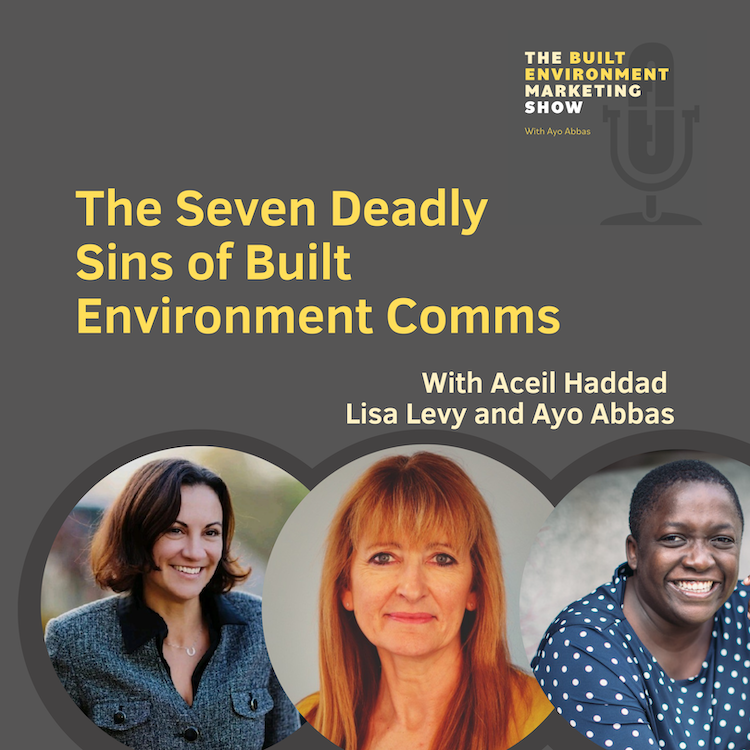
What does it look like when comms professionals get fed up of seeing the same mistakes and decide to do something about it? That's exactly how the BE Comms Collective was born.
In this episode, I’m joined by Aceil Haddad (founder of Matt PR) and Lisa Levy (independent comms consultant) to introduce the BE Comms Collective, a group of senior strategic communications specialists tackling the chronic comms failures they see across built environment organisations.
Together we break down the seven deadly sins of built environment communications: from missing the bigger picture to a lack of crisis preparedness, short-term thinking to leadership that fails to listen.
We also introduce a free diagnostic tool that helps organisational leaders identify which comms challenges are most pressing which you can access here https://www.matt-pr.com/getdiagnosed and we explain how the Collective brings the right senior expertise to each brief.
If your organisation is navigating major infrastructure, stakeholder engagement, or reputation management, this one's for you.
About the show
The Built Environment Marketing Show is hosted by marketing consultant and content creator Ayo Abbas from Abbas Marketing. It is a show that is unashamedly about marketing for architects and engineers, as well as bringing forward voices that we don't always get to hear.
BOOK A CALL TO TALK ABOUT WORKING WITH ME IN 2026
Ways you can support this show
📲 Share about the show on socials
🔗 Follow us on Apple or Spotify
📝 Leave us a review on Apple or Spotify
💬 Tell a friend about the show who you think will benefit.
More podcasts.







Transcript
Ayo Abbas 00:00
Ayo, hello and welcome back to the built environment marketing show hosted by me Ayo Abbas from Abbas Marketing. This is an episode that I really enjoyed recording because it was with two people I know really, really well. I was joined by a silk dad from Matt PR and Lisa Levy, who is a strategic comms consultant. And between us, we've got tons of built environment communications and marcomms experience. And what we want to talk about was actually about the built environment comms collective, the BE Comms Collective that we set up. It's something that we kind of have been building for the past six months, and we wanted to share more about our Seven Deadly Sins of built environment communications, because to be honest, we are seeing the same problems over and over again across major firms and projects. So we just wanted to talk about that, and that's what we've done in this episode. And those problems could be range from missing the bigger picture to having no critical friend in a crisis. They're really not small issues, and they cost projects, time, money and reputation. So if you work on complex programs or advise clients who do this, one's for you, let's get into it.
Aceil Haddad 01:13
Great. So my name is still founder of Matt PR. I work predominantly on corporate comms, but also straddle across consumer and stakeholder and political comms as well.
Lisa Levy 01:27
Lisa, Hi, I am a jack of all trades as well, but I particularly focus on stakeholder engagement, internal communications and the whole strategic piece regarding communications and marketing as well.
Ayo Abbas 01:43
Fantastic. Now, I kind of wanted to bring you on because we've kind of been, I guess, brewing an idea for about six months or so now called the be comms collective. So I thought I would bring you on to kind of talk about it and our idea and what it is. So who wants to go first? So what is the BE Comms Collective.
Aceil Haddad 02:01
Ayo, I think it's a lot of us who are doing some really great things. And, you know, no army is one person. We need a lot of us. So I think it's a number of us that have got together. We all have skills. We all like each other, very important. And we also complement each other, and know that we've that we can we've got each other's back, and we can pick things up, and at the end of the day, we want to do a good job for a good client.
Ayo Abbas 02:26
We all have bringing different specialisms, and we're all kind of joining forces because we see the same issues with the types of clients, the top clients that we're working with all the time, and we wanted to build a collective to kind of address that. And that's kind of what we did, isn't it?
Lisa Levy 02:41
Lisa, definitely. And I think we we are purpose driven. We're like minded. I saw some synergy in terms of what we were talking about, and it was the same old, same old. And what I mean by that is, although our sector has come a long way in terms of innovation as we embrace AI, as we become more educated about the actual science behind what we do. And that's important, because I think a lot of our colleagues feel that it seems to happen by magic, or is talent, or it's an, you know, insight, rather than actually an irritative process. And strategy and plan, we have the power to move the needle positively for clients in terms of reputation and brand or any of the things that we decide to help them on. But there's still an inherent issue about a lack of understanding about people like us, what we do, the benefits we bring to the discipline, how much that's going to cost. There's always a view that we can do more for less, as if it happens by magic,
Ayo Abbas 03:56
yeah, and that is one of the big issues, the more for less, isn't it? And but it's and it's also that thing, I think, as as we also spoke about when we were talking over the months was around, I guess there's a lot more junior people, and there's a lot a lot less senior people in house that we're seeing all the time. And there's that level of experience and expertise which companies still need. So that's one of the reasons we were like, actually, we've got the skills together as a collective to kind of actually bring something of value, which is what we wanted to
Aceil Haddad 04:25
do, fine, but to that point, I mean, you know, like, you know, we all we I'm from a consultancy background. I know Lisa has worked in house, but we all know that, you know, as a senior person, get wheeled out and we're back in again because your cost is too high. And you know, what we're trying to do is, do something different, where, you know, we will be there from day dot, but also be your working team, because, you know, we don't have those huge overheads, because, frankly, we just want to do a good job for the right person about business anyway.
Ayo Abbas 04:54
So talking about the Seven Deadly Sins of communications, which is our kind of playful campaign. So. So what are they? Lisa, do you want to kind of run us through them? And roughly, I guess what they like?
Lisa Levy 05:05
So starting with the first one, which I think there's no, you know, there's no order of importance, but missing the bigger picture, not singing from the same hymn sheet, short term thinking versus long term planning and thinking, this is how we've always done it, a lack of confidence, not having a critical friend in a crisis, and a lack of clear vision. Those were the seven sins that we felt were the top of the list in terms of the everyday that the group was seeing,
Ayo Abbas 05:43
and I think that's quite a wide range of, I guess, issues and challenges, isn't it? Because when you I know, like, one of the discussions that we've had in the past was recently, we looked at that kind of parliamentary review that was going on for like, one of the rail, major rail projects. And they were looking at, you know, actually, how long it takes to get things through planning. And actually quite often when you look at it, it's down to communicate, not having a strategic plan or communications approach in the first place, and then it's just getting more and more diluted. And I think when you look at a kind of a lot of the kind of major infrastructure programs that I know that I've worked on, when I've worked in house as well, a lot of it is down to the kind of having that plan and that strategy and that Guiding Light. And quite often, you don't see it. Don't see it. And I think that's where a lot of those kind of issues that you've just outlined actually come in. Where have you seen them come up with Sue?
Aceil Haddad 06:30
I mean, I think it's completely to your point. It's on every project, right? Is every project should have its own business plan, vision and end goal and and so often that is not outlined, and then not everything is pinned to it. You know, you we not always need to be looking at the end goal as we sort of drive them going forward. But so often we're so reactive to what's happening, rather than actually. This is how it fits into the timeline, and this is what matters. And then people just get, you know, they fall off the wayside. People leave naturally. And there's a turnover, you know, and Elise can talk about it more from an infrastructure perspective, but you know, that's why there's been such a cock up on so many massive infrastructure projects, is because they haven't pushed what is the end goal? What are we delivering? And why does it matter?
Ayo Abbas 07:19
The senior leaders change that vision, they might want to shift it somewhere else, go somewhere completely different, and not necessarily know what's happened in the past, which is actually quite important, isn't it, what got you there and why those decisions were made and and actually given, I guess giving it that kind of due, kind of respect, I think
Aceil Haddad 07:37
when you what can you shift? You know, like if you're building a railroad, railroad, if you're building a road, if you're building homes, you cannot change the goalposts that much. It doesn't matter. It shouldn't matter what leader comes in, because they should know what the end focus is. Yes, you can make it and tailor it a little bit more, but ultimately you have to be working to the same goal, and that's where the communication side comes into it. It's like, actually life guys, let's refocus. Let's go back to what are we doing? What's the fundamentals?
Lisa Levy 08:08
I mean, one of the biggest issues for me is the start, the middle and the finish. So what I mean by that is, I've worked on infrastructure projects where you know you've won the bid, you started work. Maybe the government has announced the start of works, or the start of the conceptual design piece, and then somebody hands you a construction schedule and says, Make a comms plan out of that. Nobody's talked about the values, nobody's talked about the ultimate benefits to the community, the stakeholders and all of the partners that you may have to work with over the cycle of the project, and so sitting down with people at the very, very beginning and working out what good looks like. Now, we know there's so many twists and turns, particularly as the construction and the geopolitical landscape changes. No one expects to have a smooth, straight journey. But what you should have at the very, very beginning is a set of visions. So regardless of who comes into the project, they sign up to those visions. They understand what the sort of culture of the project is. And more importantly, if you go out to a party, or you go and network with anybody, and you make statements at the very beginning of that relationship, the person that talks to you is going to remember all of that. So if you change halfway through, or you even change at the beginning, they'll remember every relationship is built on trust. Every relationship is built on memory, particularly with the open cons that we have now, anybody can be investigated. Anybody can look back at your past and say, but back in five years ago, you said this, what's changed? So it's about consistency. It's about messaging. Is. About agreeing what your vision is and then maybe finessing it along the way, if things change, but keeping to your core values,
Aceil Haddad 10:11
and I think often we forget right is actually more and more the hurdles that come up. What you put out there is not just words, but it also can become evidence, you know. It can become evidence into inquiries and like, you know. So we're not, we're not talking small fry things. We're not talking about little pieces of, you know, information that might may sound nice or feel nice, but actually that might be used to in the bottom line, which is terrifying.
Ayo Abbas 10:35
So you tell me it's not just about social media, which
Speaker 1 10:40
is mad, right? Doing it for the clout,
Ayo Abbas 10:43
but that's, but I guess what you say, that's actually it has legal ramifications as well as business and board ramifications, right? And people can end up in jail for certain things. And I think that's that is actually it, isn't it that people aren't taking the whole kind of strategic communications part seriously as much as they should be. And for the reasons you've just said, that's a really good point. Why do you think that is?
Aceil Haddad 11:08
Oh, why do people, why do we think that is, I think that there is a inherent lack of care about comms. You know, we can all do communications. Yeah, we can, but we can't always all do it to the same parameter, doing that. You know, that horizon scoping, thinking about the bigger picture and the long terms, and, you know, getting ourselves ready for when a crisis hits. Not all of us can do that. So many, you know, you see lots of people who come out with idiotic statements, and you're like, I wouldn't want to be there, you know. And it's just like, I don't know why you're doing that, because you haven't thought of it to be thought it through. And that's where the value of having a critical friend is, you know, say, Have you thought about that? Because actually, that might come and bite you in the bum.
Lisa Levy 11:55
So I'd like to give a recent a recent example. For example, one of our sins, missing the bigger picture to what Aceil said. Does it cost time, money and reputation? Well, it certainly did for a unnamed utility company just recently, or late last year, if you remember, there was a problem with treatment work, so that left 10s of 1000s of customers without running water, and the images we saw on the news were just shocking. And I sat there thinking, goodness me, I'm so glad that's not me. The comms failed dramatically, and the company was accused of contradictory and ineffective communications. There was unclear messaging, which left customers and stakeholders and probably regulators, confused and frustrated, the message focused around their operational issues and the technical rather than the human experience. And then the media labeled the leadership tone deaf. And although this type of event is relatively rare. This case shows you how the corporate multi comms channels broke down under crisis conditions. So where was the crisis plan? Where was the crisis communication plan which should have fallen out of the strategy, because we never, ever know what's around the corner. And if you stick to your values and you under see the operation or the business you have through the customer's lens, that is what's going to help your reputation and help you recover in the long term. Do that's
Ayo Abbas 13:42
so true. And it's really interesting, because I have a conversation recently, and we're having a conversation about how, like, you know, business leaders, and I was saying, I think that actually a lot of people are inherently selfish, so for them to actually put themselves in someone else's shoes is actually quite hard, and part of our role as kind of marketing communications people is actually to put ourselves in other people's shoes. And I think there's a lot of people that can't do that, they can't do that, and they find that quite a difficult thing. And and with that, I've got a feeling that that is why it's increasingly getting difficult for people, because they just focused on what they need from something. They're not focused on what the other person needs, or what other stakeholders or the customers. And I think that's a massive issue for people. How can, how can they like, be less selfish?
Aceil Haddad 14:34
I mean, it's where you get your advice. Is who you're getting your advice from, and who are they getting their advice from, and who they bouncing off of, you know, because we all experience things in such different light, and you've got, sometimes you have got to check yourself, and that's where having, you know, a critical friend, or somebody who can bounce off some you can bounce off somebody else, to get that different perspective, so you can see beyond your own experience. Because, you know, we're fundamentally flawed.
Ayo Abbas 14:56
But there is that thing of getting the advice, but also lift. Thing and acting on it, right? That's, yeah, that's, they're a separate beast, aren't they? Yeah?
Aceil Haddad 15:04
And offering solutions, you know, because I think that that more that, more often than not, you know, people love to, you know, chime in and give her a different perspective, and which is great and but it's also finding the solutions that that that can support all of us.
Lisa Levy 15:20
I think the preventative piece in terms of building the strategy so that it mirrors the business strategy, and then pulling that down into an operational tactical plan. If you get that right, you'll get at the you give yourself a sporting chance to succeed and be ready for most things. And my favorite saying, whenever being given advice by non comms people is so what? So I do walk in their shoes Ayo and I will ask that question from the customer's position and standpoint. So what? Or the other favorite I've got is, well, you would say that, wouldn't you, and it's not me being difficult, it's probably what is going through your audience's mind and then, and then that's when the stuff, the trust starts to erode. And I
Ayo Abbas 16:16
think, I think that is it is that putting yourself in the audience's shoes, right? And I think that is actually fundamentally what a lot of people find difficult. And I think that's a huge part of what we do as communicators. It has to be okay. So we know that comms and kind of taking, you know, taking the strategic approach, can be a bit difficult. So what kind of made you think that this collective, the be comms collective. Was something worth doing?
Aceil Haddad 16:44
Oh, another good question. I mean, do you know I was saying this earlier to somebody I'm working with joy. It is so hard to find people that you know can do the job, do it well, and have sound, solid advice experience. So when you find people like that, you've got to, you've got to find ways to work together and and I think that for me, it was like, you know, we've got to make it, make it work. Because, you know, we all bring such different skills and different perspectives and, you know, but I know, fundamentally, we'd also get the work done, which is so important at the end of the day for a client's perspective, because we don't need to dither and daly you do need to get get it done. Awesome. So how does it work? I mean, I think it's coming to us, and knowing that we are bigger than the sum of our parts, you're not going to be working with just one of us. We're going to be working with a collective, and we would also bring the right people for the job, you know? So one of the people on our team is Stacey. Stacey is an excellent writer, you know? She is a journalist through and through, she's done it years and years and years. So, you know, you're going to get something written by her with the eyes of a journalist. So we can get ahead of any of those questions, because we've got a journalist on the case, you know, we'll bring in Lisa, who has, you know, national experience doing those big strategic projects, you know, so you can, you can lean on that experience and then lean on other people as well to help execute it, or put the right people in front of of of different people. Because, I mean, again, it's it makes such a difference, doesn't it, if you're, in fact, the right person and you're having a conversation, be it a politician, be it you know Joe on the doorstep, or, you know, with another supplier that makes such a difference to the communication, because people need to ultimately, I mean, yeah, unfortunately, that's having somebody that mirrors you, or somebody that you can be akin to, just makes it So much more valuable in terms of that communication.
Ayo Abbas 18:43
So we build a tool where people can kind of take a series of questions and kind of understand which issue or which strategic comms issue might be more most pertinent to them as a business, and then we can set up a free call with you, and we can talk you through some of the ideas and concepts that are coming up for you. So, I mean, how do you find the tool, and what you've seen from some of the results with people?
Aceil Haddad 19:07
Yeah, I mean, I think the gamification of all of these things is really, really valuable, and it's really easy to have some uncomfortable conversations, let's be honest, and be able to have to find common ground, to find a language that we can we can all understand and bound by, but then also identify the solutions within it. So I think it's really good tool for people to to understand what's going wrong in a very simple way and then seek to remedy it.
Ayo Abbas 19:36
If anyone wants to use the tool you had to Matt-PR, which is Aceil's, lovely website, and you can use it there. And I'll also put a link in the show notes, the
Lisa Levy 19:46
diagnostic tool. The reason I got really excited about it when it was first designed Ayo was we learn through storytelling and case studies that really hits the mark with people. When they're confused and they know they're not doing great, but they don't know what the problem is. We're the experts. We walk in and we say, you should try A, B and C. I can make this happen for you. However, is that first piece we are bombarded with, bland vanilla, how to videos on LinkedIn, on other social, professional platforms. But when somebody actually gives you a tool that says, try this, let's see what the problem is. Let's diagnose the issue. Is so much more than education. It's about clarity and, you know, helping them find their way that it that sort of engagement really does help people work out for themselves what may be the issue, and then they know the questions to ask. They know it's say pages you, and that's what really excited me, actually seeing
Ayo Abbas 20:55
those questions in front of you makes you think it's the process of going through it. And I think those because I always think as a communication it's professional. A lot of what we do is ask questions. A lot of it is about asking questions and getting people to think of things from a different way, because again, that helps people get unstuck themselves and just, I guess, change their thought processes, which is a lot of what we do. So I think kind of tools that kind of enable you to act on your own, so you're still autonomous, but actually you're using frameworks and questions that we would use as comms, senior comms professionals. And I think that is that's the huge benefit, benefit of actually having a tool, but also it's visual, it's fun, it doesn't feel it doesn't feel old fashioned and dry. And I think that's a really good point. If anyone wants to use the tool you had to might Matt hyphen PR, which is a seals, lovely website, and you can use it there. And I'll also put a link in
Aceil Haddad 21:47
the show notes. I mean, to follow on from that, in terms of that, the execution, then, of how do you change things, is, is having people that you know are senior, are on are on board and on site, because we know that there's a huge disgruntlement of the big agencies, right? And that's because they become so spreadsheet driven, as opposed to delivering thoughtful, mindful comms, which is what we want to do, because we, you know, yes, we want to be paid, but also we want to do a good job and get things done. Because, you know, we see ourselves as the consumers, you know, I think that that's a fundamental difference. Is, you know, we want to be involved in communications, because we see ourselves as the as the end user of all things. And that's and if you start from that position, then you can only deliver good comms,
Lisa Levy 22:32
I think. And also, just to add, we are in a position, march 2026, where we know so many in house comms professionals, marketing professionals, have been let go. So what does that leave you with? That leaves you with a skeleton crew really working very, very hard with a huge workload to do the best they can, which means they become reactive when an organization starts becoming reactive, that is when mistakes are made. That is when you're not ready for something that you didn't plan for. And building confidence and keeping trust with your stakeholders and customers is the most important thing in the long term.
Aceil Haddad 23:17
Lisa, you can say it better myself,
Ayo Abbas 23:21
and that is really important, actually, because if you don't have that, that experience, I think experience is massive, because it's so funny, because, like, it's like, you know, in January, it was 25 years of me working in construction. And you kind of look back, you go, how much stuff have I been through? And you start to look at it, and you realize that actually, that is what people are paying for more of that than anything else. Because it's like, actually, yeah, I had, I had crazy things happen, you know, you like someone's, you know, someone leaving their laptop on a bloody train open, you know, or whatever, you know. And then someone live tweeting. But someone live tweeted it. I have once had someone live tweeting, live tweeting what they were reading from someone's laptop.
Aceil Haddad 24:07
I want to know more. I want to know more expensive on the pod. I ain't doing that here, but,
Ayo Abbas 24:16
yeah, that was, that was quite something, but, but I think, but you're right, having those right having those right processes in place and being able to talk to people. And actually, if you've got projects that are slightly going wrong or not going the way that you want, then actually the tool can help you kind of understand more about what you might need. And I think that's really important, is that these are complex problems. They're probably not just one thing going on, and, yeah, it's just a kind of starter for 10 in terms of how to get going, and yeah, and also how to get started and talking to us lots, that's also good as well. So anyway, thank you both for coming on to the show. Thank you very much for having us. We warmed up in the end. I will see you all soon. Thank you. Bye. You.
Ayo Abbas 24:53
Thanks so much for listening to The Built Environment Marketing Show. If you've liked what you've heard, please do share it with others on social media, as it helps me to spread the word. Thanks so much. You.