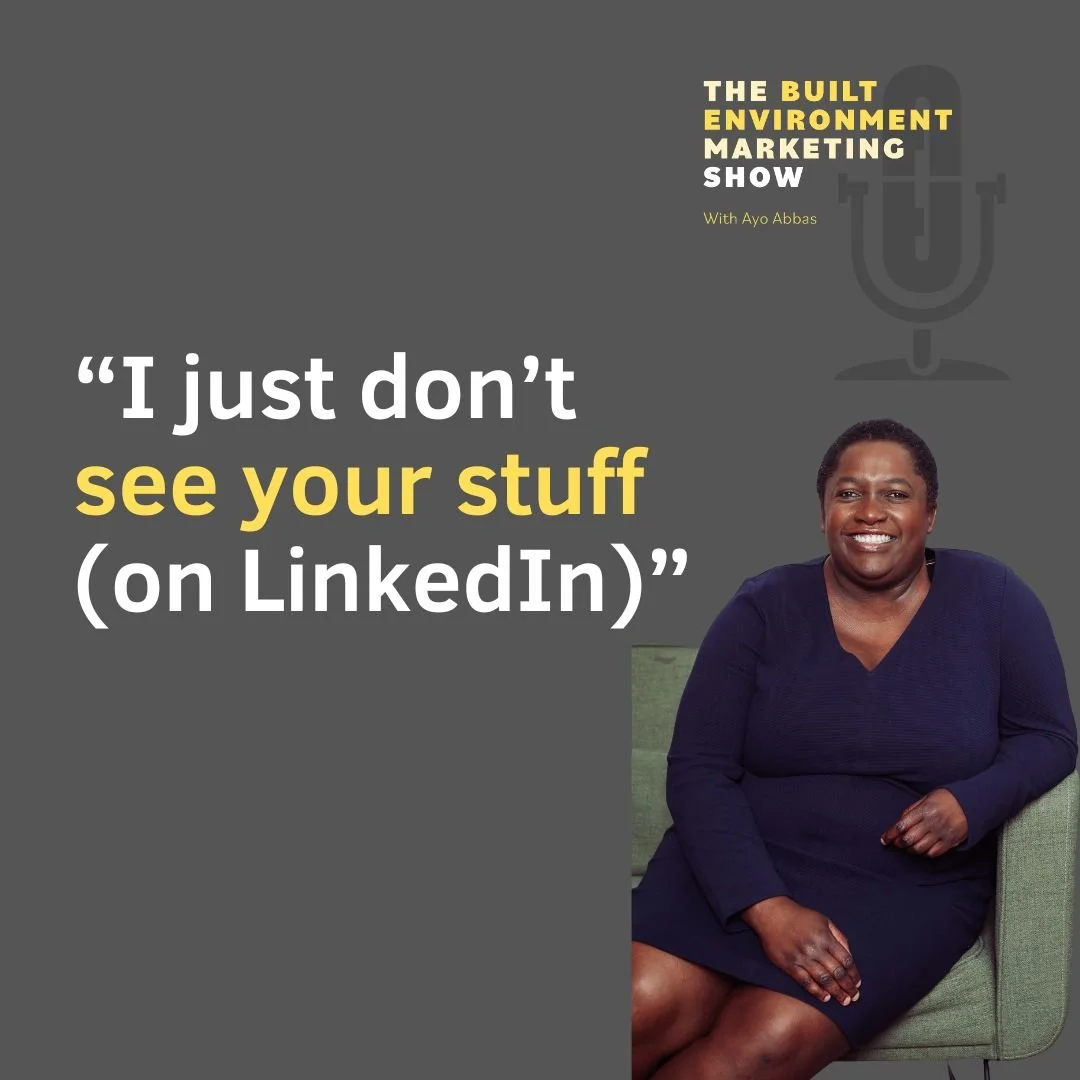
Ep 98: I just don’t see your stuff on LinkedIn
Welcome to The Built Environment Marketing Show.
In this solo episode, I share real data from my own LinkedIn performance (impressions down 17%, engagement up 19%), unpacs how the new 360Brew algorithm is changing the rules, and explain why passive scrolling is quietly killing your reach. Ifyou've been wondering why fewer people seem to be seeing your content, or whose content you've stopped seeing, this episode gives you the answers and a clear action plan.
Key takeaways
LinkedIn organic reach is declining across the board
Engagement now matters more than reach
Being connected no longer guarantees visibility
Hashtags are losing their role as content signals
Comments can outperform standalone posts.
“Want to try out my new LinkedIn post performance tracker? DM me and I’ll share it ayo@abbasmarketing.com”
About the show
The Built Environment Marketing Show is hosted by marketing consultant and content creator Ayo Abbas from Abbas Marketing. It is a show that is unashamedly about marketing for architects and engineers, as well as bringing forward voices that we don't always get to hear.
BOOK A CALL TO TALK ABOUT WORKING WITH ME IN 2026
Ways you can support this show
📲 Share about the show on socials
🔗 Follow us on Apple or Spotify
📝 Leave us a review on Apple or Spotify
💬 Tell a friend about the show who you think will benefit.
More podcasts.





Transcript
Ayo Abbas 00:03
hello and welcome to the latest episode of The Built Environment Marketing Show, which is hosted by me, as usual Ayo Abbas. I'm a marketing consultant, speaker and trainer, and I work exclusively with built environment firms just like you. If you want to find out more about my work, head to AbbasMarketing.com which is abbasmarketing.com anyway, so today's episode is one that kind of is a reflection on a lunch that I had towards the end of 2025, one of my friends, and it was a lunch conversation when we were talking about LinkedIn, and she mentioned that she just wasn't seeing my stuff anymore whenever she went onto the platform. And it was one of those things that really got me thinking, because just not seeing your stuff, and it's like, I'm always still posting and all of that kind of stuff, probably a bit less than normal, but I am still there. What I wanted to do was actually have an episode where I kind of talk through kind of when people don't see your stuff and what you can do instead on LinkedIn. Because I guess the goal posts have changed. It's now LinkedIn 360brew was the new algorithm. And, yeah, and yeah, I think that's something we've all got to think about, is how we can kind of change our approach, because the platforms LinkedIn and actually Instagram as well, as you know, the platforms are changing all the time, and they're moving towards being paid to play, so we do need to adapt what we do as well, in reflection to that. So actually, I did a RoundUp episode of this show towards the end of last year as well. So I'll put a link in the shownotes to that, but let me kind of give you some of the rundowns on my kind of LinkedIn performance. Yeah, so my LinkedIn impressions were down 17% last year because I went away and checked them after that lunch, and when I started talking to our marketing and BDs and other people who use the platform regularly, they were all facing a similar thing. And I think it's really important to acknowledge that it's not just you. It's actually happening to everybody. And I guess we are moving towards a world where all of the social media platforms, they all need to turn a buck and make profit, so they're all going towards that thing of actually, let's, you know, get people to pay a LinkedIn now has LinkedIn boost. They also have LinkedIn thought leadership ads, which are two ways that you can kind of make sure that your content gets more towards the people that you wanted to see it. And yeah, I think as we're going forward, that's probably something I will start suggesting to clients more, because actually, if you need to get your message out, put some money behind it, get it to the people who really want to see it. But anyway, that's me digressing slightly. But yeah. I mean, what was I found interesting about my stats last year on LinkedIn was the fact that my my actual impressions were down 17% but actually my engagement was up 19% so it kind of shows you where the platform's heading. They want you to have two way conversations. So fewer people were seeing my content, but the people who did see it were more actively involved in engaging with it. They were commenting, they were reacting, they were sharing and they were saving. And I think that tells us a lot about where LinkedIn as a platform is heading now, and what it actually is starting to reward. So we all need to take note of that. It's a lot more about engagement. So let's back up a bit. So before we kind of start talking about engagement, let's talk about the algorithm itself. The algorithm is basically the thing, I guess, the brain, or the multiple brains, that kind of govern the platforms. And the LinkedIn algorithm has changed over the past year. It definitely has. There's so much talk about it, how it really works. Nobody really knows. But there are a lot of people that do lots of kind of research and reports and stuff like that, and analyse data into what's happening on the platform. I will find a few of these reports about kind of algorithm, the new algorithm, and how it works, and I will put those in the show notes as well if you do want to read more. But I think the main thing that, for me, that you need to know is that things have definitely changed. And I think the thing is that, you know, it is getting harder to get your content seen. There's more people, there's more competition, and also the platforms are limiting your reach for free content, free organic content, they certainly are. And I think the thing we've all got to kind of accept now is that just because you're connected to somebody, it doesn't mean that LinkedIn is going to show them your content anymore. And I think that's something we all now have to, now have to accept the algorithm is actually prioritizing content from people you actively engage with. So basically, if you've been passively scrolling by someone's posts and not stop, not stopping, not commenting, not engaging, not reacting, LinkedIn will just stop showing you their stuff. And that's how you're going to kind of drift out of the kind of radar of the people whose work. That you may actually want to see. And I guess that's one of the things that you know, that I said to my friend as well, is that you know you have to start to be more active with your engagement. So you got to kind of either like, ring my bell, comment on my posts. And I think that's what we've all got to start doing, is being more active about what we want to see on our feeds, and taking the action and the steps to make that happen. And I think that's something that isn't going to change from here on in, we've all got to be more active. But I think with 363 60 brew, the new LinkedIn algorithm, the other thing to think about is that, rather than hashtags kind of telling LinkedIn what's in your post or something like that, they've kind of become more or less redundant. In that sense, the post is now being read by the algorithm itself, and it's making its own decisions. So if you want to develop content, you need to think make sure that your content and your profile and everything, all the signals that you give LinkedIn are saying who you want to work with, the types of people you work with and speaking to that audience and the content that you're putting out. So don't be completely random. Stay on topic, and you should start to see more results. And I think the other thing to think about is comments. There was a week a few months back, where I actually did a comment on a post, and that one comment, which, to be honest, wasn't actually that interest in actually got 26,000 impressions, which was way more than a lot of the content I've been putting out over a couple of weeks. That one minor comment, which was a throwaway one, actually was on a fireball post early. But anyway, that comment got a huge amount of reach. And what was interesting is that when I did a post about that, lots of people came back and said they were finding that too. So comments are outperforming posts in many cases. So actually, if you aren't, if you're looking to connect with certain people, you want to do business with certain people, make sure that you are being active and that you are following them, and that you are reaching out and commenting on their stuff, because that is another way to a get more visibility for yourself and to build those relationships. And I guess you are given a signal to LinkedIn that you want to be there and you want to be social, not just present. So in terms of marketing and BD in the built environment, I think the thing for me is that when people are using LinkedIn for business development, I think the old model was pretty straightforward. You show up consistently, post a bit, tag a bit, you know, and then you just connect with who you know, and that's absolutely fine, and the algorithm surfaces you to the right people in your network. Approach impressions were always going up. Visibility grew easily, easily. Sorry to say it, but you know, things just aren't quite working like that anymore. So I think you have to be more intentional with what you're doing and how you're using the platform and what your goals are. Really put some thought into what it is that you want to say and how and to whom, and really make sure that you are engaged in connect with connecting with those people. I'm not actually saying to people you have to post five times or three times a week anymore, because actually one decent post a week and a few comments, and then actually knowing you know who you want to talk to, I think that would be much more valuable to you as a firm right now, especially if you want to kind of connect with the right people. I think the other thing is, yeah, if you want to see people's stuff, make sure you're reaching them, and you're commenting, following them, ringing their bell, doing all of that stuff. But the reverse is true. Whose stuff have you stopped seeing recently? Think about that. And if you think there's people's stuff you haven't seen for a while, go back, do a quick search in the search bar. Are they still posting? Were they just no longer on your radar?
Ayo Abbas 08:52
If you see that they're no longer on your radar, make sure you ring that bell. Make sure you comment on a post. Get them back in your feed. Keep on building those relationships that you've already started and you can re engage. That's so important. It is really important to be active and present in other people's world, particularly when it comes to online networking, which is what LinkedIn basically is doing. So if there's one thing or a few things you should do off the back of this episode, I have to say it's all about active engagement with the people you want to hear from. Do some thinking about who those people really are. Don't wait for them to show up in your feed. Go to their profiles, comment and something you want to give the algorithm the signals of the stuff that you really want to see and the topics and content that you enjoy. Tell your audience what you need from them if you want them to like something, ask them. If you want them to share something, ask them. What's really interesting I found is that actually they're changing how the stats work on LinkedIn as well. So for example, they're starting to look at sends and shares and saves a bit more like. You do on Instagram, for example, and that's actually something that I've started to look at as well and profile views. So I've started to map out what they are each week from each post I do, and then you can start to see the patterns of what's resonating. And actually, I was bored last week, and I created a vibe tool, which is a LinkedIn post performance tracker, so DM me. If that's of interest, I'll drop you a line and I'll share it with you, but it's really interesting, because then you start to see the patterns of what's actually working. And I actually went back and looked at my data from January, and just looked at that wider piece of the sends, the shares and the saves. And I think that's the story we've all got to start doing the way we measure and the value of what we get from LinkedIn is changing, and we need to change how we approach it and how we also how we track it, as well as with all social media. The key here has to be about diversifying where you are. LinkedIn shouldn't be your only channel anymore. It's just too hard, and it's too if you put all your eggs in one's ones, but in one basket, you know that that's massive risk to you and your business. And I think we've all got to make sure that we are using social media and LinkedIn and any other you know, as an integrated channel. So there's other things that you do, be it newsletters, be it going to in person, events, be it speaking, going on podcasts, whatever works for your audience. We've all got to make sure that we are kind of spreading ourselves across a few more channels just to make sure that we're safeguarding our businesses and what we do. So yeah, that is my episode. Thank you so much for listening. And yeah, it was good to know that I wasn't actually being ignored by my friend anyway. But yeah, it did make me stop and think and look at my performance and fix a few things, which I hope you will do too. And yeah, there's lots of links I'll put in the show notes to various articles and pieces that can kind of give you more in depth on the whole thing about how you can get more visibility on LinkedIn in its new state. And yeah, that is it from me for this episode. And if you liked anything you've heard, do drop me a line. My email is Ayo@Abbasmarketing.com and of course, I do offer LinkedIn training, if that's of interest to you too, and I might well do some stuff around performance and LinkedIn training in the coming weeks. So I'll share more on that too. Take care. Bye. You.