Ep 97: 25 years on what's really changed in construction marketing
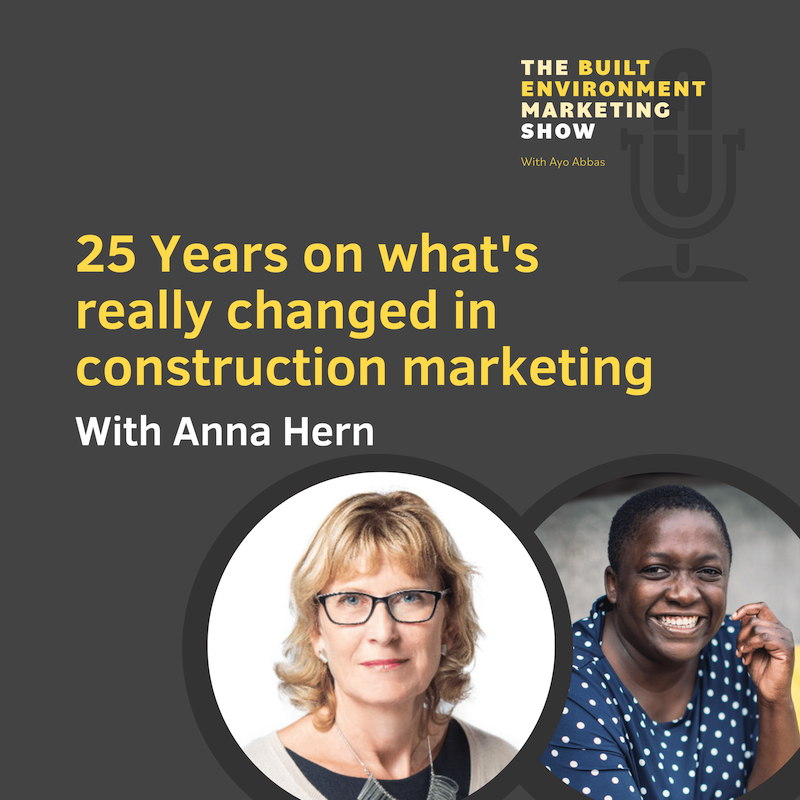
Welcome to The Built Environment Marketing Show.
To mark me working for 25 years in the construction industry, this epsiode is an interview with my very first boss, Anna Hern from Ridgemount. Together we chart the evolution of construction marketing: from the old PR vs advertising divide, through the explosion of digital channels, to the AI era we're now navigating.
Anna brings sharp, no-nonsense realness on what great clients look like, why strategy is still misunderstood, how digital measurement changed everything, and the counter-intuitive case for investing in your brand hardest when the market is at its toughest.
Key takeaways
What great clients do differently (and strategy vs tactics)
Trust, AI, and the role of media / gatekeepers
Expectations, complexity, and measurement in modern marketing
Future-facing skills: brand building, critical thinking, and using AI well
Links
About the show
The Built Environment Marketing Show is hosted by marketing consultant and content creator Ayo Abbas from Abbas Marketing. It is a show that is unashamedly about marketing for architects and engineers, as well as bringing forward voices that we don't always get to hear.
BOOK A CALL TO TALK ABOUT WORKING WITH ME IN 2026
Ways you can support this show
📲 Share about the show on socials
🔗 Follow us on Apple or Spotify
📝 Leave us a review on Apple or Spotify
💬 Tell a friend about the show who you think will benefit.
More podcasts.







Transcript
Ayo Abbas 00:00
Ayo, hello and welcome to the latest episode of The Built Environment Marketing Show hosted by me Ayo Abbas. And this year is actually my 25th year of working in the construction industry and its various guises. So I thought, Who better to interview than my very first boss? So my guest today is Anna Hern, and she's from an agency called Ridgemount. And Anna, would you like to introduce yourself? And I guess how you we know each other?
Anna Hern 00:33
Well, the fact that you've just said 25 years in the industry and I was your first boss has suddenly made me feel horribly old. But there we are. Yes, I You came to work for us when I was a director at CIB, I think, and you were an account executive starting in your
Ayo Abbas 00:47
first job. Is that? Right? That's my first job after uni.
Anna Hern 00:50
Yes, yeah, excellent. Now that's how we know each other and what you doing now. I owned Ridgemount for 15 years, and I've just sold it to to Kate, who has been working for Ridgemount for 10/15, years, going anywhere for a bit. I'm hanging around for the next few years, but we just wanted to make sure that we'd sorted out the future direction for Ridgemount.
Ayo Abbas 01:13
So that's what we're doing. And what does Ridgemont do?
Anna Hern 01:17
Ridge mount is in a state of transforming itself. Ridge mount started as a media relations agency when we were called Ridgemount PR, but we introduced digital marketing fairly early on in the trajectory of digital marketing. We were pretty much ahead of the curve in construction industry marketing at the time when we started doing paid social and digital content sharing, and we That's mainly what we do now. So we've dropped the PR from our company name to focus attention on the fact that we don't just do media relations. We still do media relations, but it's really not the bulk of what we do anymore. And I think we're probably going to come on to why not later in this fight, really.
Ayo Abbas 01:56
Okay, now that's a brilliant introduction. So do you actually remember anything from like working with me, because it was a while ago. I remember stuff still at CIB in a
Anna Hern 02:05
little in little brief you sent over before this podcast. You said, What do you remember about me when I started and the first thing I put down was your laugh that still happens, that still happens. It still happens, absolutely so that I remember your enthusiasm and your just general loveliness and noise. Once you settled in,
Ayo Abbas 02:25
yeah, once I find my feet, I can be quite noisy. But before that, I can be like, I just look but,
Anna Hern 02:30
yeah, that's great. When you have lively people who are not afraid to say what they think. That's the sort of people you want to work with.
Ayo Abbas 02:37
But I mean, I guess one of the things that fascinates me about, I guess, the construction industry and, like, well, I did a LinkedIn post, which was literally from, like, my second week at CIB, with me sitting on that Williams girl, which I will share in the show notes. But like, what fascinates me is the way the industry is kind of, it's changed, but then it's also the same, right? It's kind of, there's so many things that's still consistent from, I mean, even 25 years ago or even before that, but like, there's also, I guess, marketing's changed. The industry's changed. You've got new channels, like digital stuff. So what I guess, what changes have you seen in the industry? Well, all I
Anna Hern 03:11
needed to go when you joined what was basically an integrated agency, wasn't it? And we had PR team on one side and advertising team on the other side. And they were two very different blends, and they didn't really, I mean, it wasn't unusual for us as a PR team to be working with a client who used a separate advertising agency. The two were seen as very separate. This is advertising, this is PR, and everybody knew what the difference was. And I would say the main difference is that things have changed to the point where that distinction is far more difficult to identify. Now, what's advertising, what's PR, I don't know, do you, and so I think that's probably the main difference. So what's changed has been the channels you can use, the way of getting your message to your audience, but the fundamentals about understanding the messaging, understanding your audience, knowing how to communicate those fundamental skills still the same. What's changed is the way you get to the people you want to talk to. That's what's changed. Yeah.
Ayo Abbas 04:09
And I think one of my biggest observations is just that, if there's just so many, it's like there's so many different channels. Now it's such more. It's a much bigger landscape to actually cover, isn't it? And it's like picking the ones that are relevant and making sure you're using in the best way possible, and you're getting the most out of that channel. And then what makes it even harder, I think, is also that thing about the channels are also ever evolving as well. So it's like, how do you keep up? How do you stay relevant? How are you doing the right thing? I think that's the biggest thing for me.
Anna Hern 04:38
That's what makes it fun, isn't it? I mean, you talk about the channels evolving, and of course, they do, and they do change. There are more of them, but you could argue that back in the day, we were making choices between different publications and different publishing houses, and now we're making a choice between a different platform or channel. The choices are still still there, maybe made on different assumptions, but you're. Still making choices all the time, because you never have enough budget to do everything, so it's still a question of prioritizing and working out what's going to work most effectively
Ayo Abbas 05:08
for you. So what do you think that great clients do differently?
Anna Hern 05:13
What do great clients do differently,
Ayo Abbas 05:15
as opposed to ones that aren't so great?
Anna Hern 05:18
Okay, I was thinking about this. And I think the difference in terms of working with clients and achieving their objectives, the fundamental thing that I think a really good client has is consistency, so they know what the vision is. They're not changing their mind every two seconds, and they give a campaign time to evolve and to work, and also that they're clear in direction. There's nothing worse than indecision. And the entire organisation feels that if the person at the top of the tree doesn't know how to address something and doesn't doesn't articulate a clear path for the company, then it's very hard for everybody else to follow through and make anything happen, would be my summary. I think there's also something
Ayo Abbas 06:01
I doubt as well, around buying that kind of client, buying across the piece. Because I think sometimes if you don't have it in at all the levels, because you might not be seeing this CEO all the time, but actually, if you don't have it at that level, then actually, is that ever going to be successful? Oh, absolutely.
Anna Hern 06:18
And the worst situation you can have is when the marketing team that we're reporting to aren't getting any clarity from the top, because then they don't know where they sit. We're giving our advice from our side. They're not getting any direction, strategic direction from the senior team, which in itself is a revealing comment, isn't it? Because Why isn't the marketing team considered to be equal footing to the financial team, the HR team and the strategy team, yes, but that's another debate. That's another debate, yeah, but I think that's the major problem. If there's no consistency and no clear vision, then how can we help you get there?
Ayo Abbas 06:50
Yeah, that's a good point. And do you think the client's expectations have kind of shifted over, say, 25 years or even longer?
Anna Hern 06:58
Oh, my God my god. Can you remember the kind of report, monthly reports we used to put together for clients. The sheer volume of what we do, the variety of what we do, the range of expertise that we deliver now is just out of all recognition to what it was 25 years ago, wasn't it? You had a PR team who focused in on writing good content and developing great journalist relationships and being pretty good at organizing events, which was one of your fortes I seem to remember. I mean, now, I've just finished a program for a client where we're doing a three month LinkedIn campaign with a series of what would have been described 25 years ago as ads, a whole series of them, and that's delivered in one month creative concept, strap lines, copy assets, the lot, they all gone in one month. And that's a typical month.
Ayo Abbas 07:46
It's huge. It's funny, isn't it? Because that is a very, very different it's a different model altogether, isn't it? And I guess you're having to evolve as an agency all the time, and if you're in house, you have to evolve with all of this as well. It's a lot of speed, isn't there is a lot of change.
Anna Hern 08:02
There is that's kind of what makes it fun. I don't think I'd still be here all this time later if it hadn't changed substantially. And it's fun, and that's the challenge, I think, particularly for the in house teams, where they might have one person with the title digital marketing who's expected to be able to keep up with everything, and we've got a team of six people whose job it is full time to tell us what's changing on all the platforms. You know, how? How can an in house person keep up with that, which is obviously both our challenge and our opportunity as an agency?
Ayo Abbas 08:32
Yeah, no, that's, that's a really good point, and that's actually often where I get commissions, is actually when people are like, Oh, we just need to have an idea on what's happening on LinkedIn is like, yeah, I am on there every day, but, you know, but I love following the platform and learning all about it. And I think you're right. It's that thing of, I can scan the market and go, This is what you need to know and what's going on, and share that with people, because you're right in house. You've got so many different levers to be putting it it is, and it's just growing all the time, isn't it exactly? So when it comes to strategy and tactics, how do you find that clients are, I guess, how they tackle it? Are they doing it well or not so well?
Anna Hern 09:11
Oh, that's such a good question, because most of the times when we or often when we get a brief, the difference in definition between strategy and tactics is one that isn't always very clear, and that you can find somebody defining their strategy as being we need a new website. What's our strategy? That's a tactic. What are you trying to do? So the best way for us to work with the clients to understand what your end goal is, because that's the strategy. What's your end goal? Are you trying to reach this new market sector? What's your strategy? You're going to undercut your competition, are you going to be more technically adept? What is your strategy and how are you going to convert that target audience? And then it's up to us to work with the client to understand the tactics you need to achieve that result. So that's actually a really good, really good question, and it's one we've always struggled with in pictures to one of those pitch documents that used to have strategy at the beginning. Then tactics, and we'd all spend hours wrestling, Abbas sat a strategy or tactic. So be clear right at the beginning, where you where your argument sits.
Ayo Abbas 10:08
I think it's that, but it is you're absolutely right. And I think one of those things for me is that, like, I always kind of think is, like your strategy is your kind of, your Northern Light, your guiding star, kind of thing of like, this is where we really want to go. But then I also do and I but I think my main thing is that most clients aren't searching for strategy because they don't think they need it. And I think there's that kind of weird. There's always this disconnect. I find it's like, when you start talking to someone, you're like, Okay, so you need a new website.
Anna Hern 10:34
But actually, why? But why? Yeah, why?
Ayo Abbas 10:38
So what you know, and and that is actually that conversation is the thing that takes you above, back into that strategy bit. But I think it's also finding a way for clients to kind of value the strategy and the thinking part, which I think agencies and in house and any consultants like me, I think that's the hardest part to kind of say to someone, actually, we need to do this thinking beforehand, before you move, because I feel like people take strategy and they go, actually, I don't need this. We should just be focusing on moving and doing tactics with doing as I always say. But I think there is this whole thing around actually, the strategy and the thinking part is probably one of the most important aspects, and that will carry you through for years once you've had those hard conversations fully.
Anna Hern 11:20
And it depends where, as an agency, you're brought into that process, because if you're, if we're being, and we can fit in in various different ways, of course, if we just being, if we just if we're being asked to be the delivery partner, because the in house team has really worked out the strategy, understood the target audience, knowing what their messages are. And we're basically given a brief saying, This is what we want to say to that audience, happy days. We'll get on and implement it. And that's great. And that does happen, and we can do that very efficiently. The more the ones I tend to get more involved with are the ones where that thinking maybe hasn't been completed. And we're asked to do a series of tactics like, how much, typically, how much would a PR campaign cost? Or how much does social media cost? And my question to that would be, well, where does that fit within your overall strategy? And that can reveal the fact that maybe, as you say, maybe some of that thinking isn't complete, and that would be a good point for us to be able to advise. Sometimes, as an agency, we give away that expertise for free, because what we're actually looking for is the delivery activity that is our bread and butter. And actually we shouldn't.
Ayo Abbas 12:31
There is value in strategy.
Anna Hern 12:34
Was doing the thinking right at the beginning, yes,
Ayo Abbas 12:37
but I love about the strategy is, you know what? When you look at a client and they suddenly come back and go, I used what you said in a meeting, and I've done this, and you could see it just kind of, it all starts to connect. And I think, but you have to do that thinking beforehand, to really, kind of understand under their skin, really. And I think that's the part where people don't necessarily realize that is what they need, and that's what they should probably
Anna Hern 12:58
be No. And sometimes it's a kind of a softly, softly approach. So it's not unknown for us to make some quite strong recommendations one year and to find they've cropped up in the plan the following year.
Ayo Abbas 13:08
Niko, I have to admit, like when we worked in the marketing team at mace, one of the things we would say is that you drop an idea and then in about three years later, you'll see it in the business plan.
Anna Hern 13:21
My point precisely, and that's fine. We're an agency. Our job is to make our clients look great. So if the marketing team that we're reporting to has taken an idea and it's flown, fantastic, yeah,
Ayo Abbas 13:32
and that's what we want to see. We want to see people do well. So as, I guess, as an agency, how do you kind of balance the whole kind of the brand, piece of ridge man, and having to get out and win work, I'm gonna say for yourselves and business development, well,
Anna Hern 13:47
that's an interesting one, because I think the thing we're weakest at as an agency is marketing ourselves. So funnily enough, we're actually what we've done at the moment is we've commissioned another agency to look at our branding and our proposition. Because although obviously we could do it, we never do because it's never the number one job on the pile, because the clients always come first, and you don't get around to looking yourself. So we've employed somebody else do it
Ayo Abbas 14:13
for us. So back to PR and kind of reputation. So at the moment, there's quite a lot of kind of talk about with the on, with the kind of advent of AI that PR is back in vogue, and media, that whole kind of PR is kind of back in vogue, and you need it because the llms are pulling through magazines and titles. So what do you think makes PR valuable nowadays?
Anna Hern 14:38
Your definition of PR there from the way you phrase that question being media relations.
Ayo Abbas 14:42
Yeah, I that probably is people's most traditional definition, even though I know it's not the right definition.
Anna Hern 14:49
It's a very important distinction. But let's, let's take that question in the way you phrase it, and talk about media relations. I've said for some time that I think the pendulum will swing back when people. Realise that they need that trusted gatekeeper, if you like, between what we're trying to say and what that audience wants to read. I was really hoping that would happen faster. I don't think it's happening yet, actually, because I thought it would happen with the national press. Okay, so let's take the national press as the example and the whole freedom of speech thing. To my generation, we grew up thinking that freedom of speech was absolutely what we believed in. Would have campaigned for it. We live in a democracy. Freedom of speech is what we want. Turns out, we didn't want freedom of speech. What we actually wanted was a free press that was overseen with some moral compass, ie, had people whose values we fundamentally agreed with, going, what's going to be our guiding principle editorially, so things little, things like checking your facts, not slandering people, keeping those kind of things. That's the kind of controlled free speech that my generation believed in. What we've got now is free speech, and it looks horrible to people like me. You go out and have a conversation with somebody who's getting passionate about their views on something, how often do you unpick it and go, where did you read that? Where did you see that? Why do you think that? What are their sources? And I would like to think that people were starting to understand the rubbish that were all being fed and were lining up behind organizations that still had some sort of editorial integrity and value, but I'm not really seeing that at the moment. I've got one of my interview questions for people that I used to employ was always what newspapers do you read? Well, if I just stop asking that question a long time ago, but I ask all my staff and people that we interview, where do you get your news from, and how do you trust the sources that you're using? Fundamental one, Wikipedia. Wikipedia was one of the first online information sources to come out, wasn't it, and all my team had Wikipedia at school, and they were all warned, don't use Wikipedia because it's not reliable, and we've all treated Wikipedia with a certain amount of skepticism ever since it's been around. Well, it says that on Wikipedia, but I better just check that first, Wikipedia is one of the most reliable news sources in the world, because it's really hard, it's really golden, it's rich, and it's really well controlled, because it's got a whole pile of people who are interested in getting the facts right, making sure the facts are right. Ai comes out, which has no such controls, scrapes things from the internet with absolutely no way of checking whether that information is correct or not, and suddenly everybody's treating it like it knows all the answers and it absolutely doesn't. We will all get tired of that eventually, and we will all start to see that all AI is doing is scraping the answer that it thinks you most want to see with absolutely no reason for you to assume that answer is correct. I would like to think that's the case. I'm not really seeing it yet.
Ayo Abbas 18:01
Are you a practice leader who isn't getting the industry profile that you deserve? I often hear from practices who do brilliant work but aren't actually getting the visibility they need to get business through the door. Practices that influence the sector aren't necessarily the best at design. They're often better at positioning their expertise and getting it seen and valued by those with budgets. I'm Ayo Abbas, and for 24 years, I've helped leading built environment firms build the recognition and authority that their expertise deserves. Drop me a line at Aya@Abbas marketing.com which is Ayo@Abbas marketing.com to set up a call where we can talk about how I can help you get a strategy and plan in place to get you to where you deserve to be. It's really interesting. I think the whole critical thinking thing is massive, and being able to look at something and think, What are you trying to do? I mean, like you've got, like, AI, and it's basically there to kind of tell you you're fantastic, and what you're doing is great, right? It doesn't unless you tell it be honest, right? And you have to keep
Anna Hern 19:10
telling No, I love the fact that it's polite to me,
Ayo Abbas 19:14
no, but it will always go, hang on. It's a fantastic idea. Oh yes, it is. Anna, of course it is. That's a fantastic idea. Maybe we should turn it green, you know, and, but that's why it's there, because it's like anything, isn't it? Like you go on, it's do what I love doing, actually, is slightly bursting the social media bubble of my son, who's 10 years old, and sort of telling you do realize that's an ad. You do realise that someone's put that there and, like, you know, like just actually making him realize when he's going online on that YouTube channel or whatever that, you know, someone's paid them to go to that store, or someone's, you know, when you realize how much these people are earning? Because I think that whole criticalness and understanding that these algorithms or whatever they want to keep you online, they want to show you more stuff, so you're outraged, and you stay on there and how they make their money. And I think. Think until we start to kind of, as a society, really acknowledge that, and go, actually, if you're reading media from here, this is what it's doing to you, and that's, it's a big fight, and I think it's a massive fight because they've got such deep pockets. But yeah, so kind of got slightly off topic.
Anna Hern 20:15
Yeah, we're slightly off topic because your question was about, do you think there's a drift back towards some kind of editorial controls in the information that's in front of you. I would like to think so. I'm not sure I do yet, and that's a big issue for all brands, but what it means to me is that you have to spend a long time building up trust in your brand, because trust is the biggest issue. If people do, people trust you as an information source, and that isn't something that happens overnight. And you can build up trust in your brand if you're consistent and your messaging is accurate and you're telling your audience things that you're interested in that helps them do their job, you can build that and that's your sweet spot. If you can get to the stage where your audience thinks I've seen a piece of content from this organisation, actually, that's usually informative, interesting and helpful, brilliant. Yeah, don't forget, I've worked all my life with product manufacturers, and getting product manufacturers coverage in any of the trade journals has always been a challenge, hasn't it?
Ayo Abbas 21:16
But we, back in the day, we had, I don't know, do they still have color separation charges. I remember those are, like, 100 No, I do. That's what I remember. It's like, you had to do that. I think we even had a fax machine, but anyway, but like, I do remember that. And I think there is that line, isn't there, and that's that line which you've got now, which is between the paid and organic, right? And it's like, kind of, you can't, not. Publications still need to make money in keeping business, and I think that's where it's all kind of the blur is happening as well, isn't it?
Anna Hern 21:45
Well, yes, absolutely. And that was always the case, wasn't it? I mean, it was less overt back in the day, but there was always a link between who paid for advertising and who got PR coverage that and that's no different. Now, it's perhaps more obvious, but no different. And again, advertising on a digital platform. What is that? We make no bones about it. We use paid social a lot to get messages in front of people. It's just a different way of getting the message there. Yeah, what matters is what you're saying to them. So that's why I struggle with the difference between advertising and PR. Well, I don't struggle Well, I don't struggle. I'm very clear on where I have on the issues other people I love. So if I'm using a LinkedIn post to get my message to a very select target audience that I've built on LinkedIn, if the message happens to be a 300 word feature, and what I'm looking for is people to read it, and I use paid to get there. What is that advertising or PR? It's a very blurry line, isn't it?
Ayo Abbas 22:47
Yeah, and that's but that is where we are. But also, if you've got clients, particularly product manufacturers, who you like you said, can't necessarily get the traction in in the journals in the same way as an architectural firm or whatever, or a consultant can, then it's like, actually, we still need to get that message out there. And as an agency, you also need to report back, right? You've got to show the impact of your work and their business on their business, yeah.
Anna Hern 23:11
And that, to me, is one of the best things about digital. Back in the day, when we used to do our coverage reports to clients, and you'd go Trent, we used to list it, you've got page in here, you've got page in here, you got a quarter page in there, and we'll add up all the circulation, and we'll say that's roughly the number of people that could have seen it. And we'll, you know, some agencies used to add a percentage on for editorial integrity, and we'll give it an advertising equivalent cost. And it was all a bit hooky, wasn't it? It was the best we could do at the time, but it wasn't terrific. What I absolutely love about digital is, if you've got your mechanisms and your tracking set up properly, you can demonstrate who's read what and how long they've spent there. I mean, it does depend on your being able to set up your analytics and try to get tracking properly, but to being able to demonstrate that you've had that many people have spent this long reading that piece of content means you can show you've done your job. I've got that message in front of them and they've read it, yeah?
Ayo Abbas 23:59
And you got those lag into indicators, haven't you European traffic, and looking at their overall kind of what's going on across that business from that campaigning activity you're doing, but you're right. Measurement has just gone off the scale in terms of what you can measure now and what you and I have to admit, one of the things I love is when even just showing clients their Google Analytics dashboard and I suddenly go, we actually have metrics. It's like, yes, these things existed. Someone just needed to set them up. But you know what I mean? It is just like, I mean, I spend a lot of my time working with engineers, and they like numbers. It's like, I show them numbers, and they're like, oh my god, numbers can be
Anna Hern 24:36
very compelling, can't they? They certainly can, especially if you want more budget. And the way the social media channels are evolving is really in is really interesting, because the way they're starting to try and authenticate the numbers they're showing you is quite interesting. If you look at me, you're on LinkedIn all the time, so you can see what they're doing in terms of trying to bring some genuine rigor to the numbers they're giving you, which is very welcome, as far as I'm concerned. So terminology is really important, isn't it? How many link clicks? Well, what do you mean by a click?
Ayo Abbas 25:04
It's an impression. Is it not
Anna Hern 25:07
impressions and reach? And the terminology is tricky, especially if you're reporting to a marketing team who isn't always focused on digital marketing, and they and why should they be? It's not their specialization. But to be very clear about the language that you're using and what you mean with the numbers, because you can easily bring in all sorts. I mean, you can make a number look however you like. Can't it. But what do you actually mean? And what are you trying to achieve with that piece of content? And you have to be really clear.
Ayo Abbas 25:32
But also, well, it means that business, and I think some of the best digital campaigns I've done is actually, I remember that we were reporting to the marketing team all the kind of metrics behind what was going was going on with the campaign. They had all of that. But actually what they took to the business was, actually, we've had this kind of this target account has kind of seen this, this content, this amount of times, that kind of stuff. And that was all they took up senior level. But actually what they were doing for themselves was they had all the metrics for themselves, and I think it's just that conversation and what your business is expecting and what that what will really keep them engaged, right?
Anna Hern 26:07
And that's one of the core skills nowadays, is figuring out what to report and how to set it out in a way that isn't just loads and loads of numbers, but what do they mean? Yes, what
Ayo Abbas 26:19
does this mean? What do we need to do next. And I think that's, yeah, that story is that narrative around your numbers, which is always lovely. So what should in your future? This future? Anna, I'm going to talk about the future. So what should firms be investing in now for the next five years? In your opinion,
Anna Hern 26:36
what should firms be investing in now for the next five years? The first answer that came to mind is understanding how to use AI effectively, because that's something that we're all dealing with. I mean, a fantastic resource, but only if you use it properly. But also, I've put don't get too distracted by the shiny stuff. The fundamentals actually don't change. So keep faith with some of those fundamental core skills that you actually need about understanding your market, your audience and your messaging, because those are actually still the most important things.
Ayo Abbas 27:06
Yeah, I agree. It's like, who, what, where, why, how? I always think that's just such a kind of Yeah, that stuff
Anna Hern 27:12
that used to be how to write a press release edition 2.0 wasn't it for that one of the first sentences you've done, and that hasn't really changed, has it? Because you're looking at social media posts. Now, the same discipline applies exactly,
Ayo Abbas 27:23
but actually, I think you can also apply that to, like, who you're talking to what you're doing, you know, like, it's still the same questions. And I always, I always kind of frame it around that, because I'm like, actually, as long as you're doing that, then you understand where you're going. And I think that's really important. So what things like, oh my gosh, I write that question, what way we laugh about in 10 years time,
Anna Hern 27:43
early digital marketing. I think probably one of the most fantastic things about having a long memory and a good computer system is you can look back at the pictures you were writing eight, 910, years ago and laughed your socks off. I think we used to win business like that, but haven't things moved on? Haven't the range technologies, the range of the skill sets we can offer just even how the presentation looks? My God, we that was an acceptable form of presentation 15 years ago. Okay, it's funny.
Ayo Abbas 28:14
You don't realise, though, do you, until you actually look back and you suddenly go, Oh my gosh,
Anna Hern 28:19
I know. It's very reassuring, because you think actually we're quite good at what we do.
Ayo Abbas 28:23
So what skills? Finally, what skills do you think would matter most to marketeers coming through? So what do they need to kind of gym up on?
Anna Hern 28:30
Well, it's sort of reiterating what I've said before. I don't think the fundamentals have changed. The delivery mechanisms are what have changed. But that shouldn't that shouldn't overwhelm consistent, strategic thinking, and that's the bit that we're all struggling with now, because everything, every tactic that we're doing, is so fast moving and fast changing that it's easy to lose sight of actually having a clear strategy and a clear vision for what you want your brand to be doing. You did ask an interesting question, or you were going to ask an interesting question, which is about how you balance brand versus business development goals. And I think it's really interesting at the moment in a tough market, because what happens in a tough market is, or seems to be. What happens is, companies tend to shift from doing brand building towards lead generation because they suddenly need sales now? Yeah, I've always thought, I've always thought counter intuitively. That's kind of the wrong way around the time that you really need to be investing in your brand is now when the market conditions are tough. Because if you can grow your brand awareness and grow your brand value now, then when the market picks up, you'll accelerate straight out of it. So always, but you could, you can say that to be blue in the face, but faced with a do I cut my marketing budget, or do I lose a member of my team? You know which way you're going to go,
Ayo Abbas 29:48
yeah, and it's but it's also like, also that brand building thing about brand building versus performance, isn't it? Performance marketing, actually, yeah, the short term leads are going to take, it would take longer to convert, because they don't know your brand. You know, so it's going to cost you more.
Anna Hern 30:01
That's exactly my point. That's exactly my point. If you're trying to sell something on the back of low brand visibility, it's much harder and much more expensive. If you've got great brand visibility and everybody and your audience has a clear understanding of what your brand is, then selling your individual products and solutions is is cheaper and quicker.
Ayo Abbas 30:20
Absolutely on that lovely note. Thank you so much for coming on to the show,
Anna Hern 30:25
Anna. Oh, that was fun.
Ayo Abbas 30:27
I hope you enjoyed it. I'll put links to Ridge mount and also to Anna in the show notes. Thank you, cheerio,
Ayo Abbas 30:38
thanks so much for listening to The Built Environment Marketing Show, don't forget to check out the show notes, which will have useful links and resources connected to this episode. You can find that on www.Abbasmarketing.com and of course, if you like the show, please do share it with others on social as it helps more people to find us see you soon. Ay