The rise of Manchesterism, collaborative development and growth with Tim Heatley
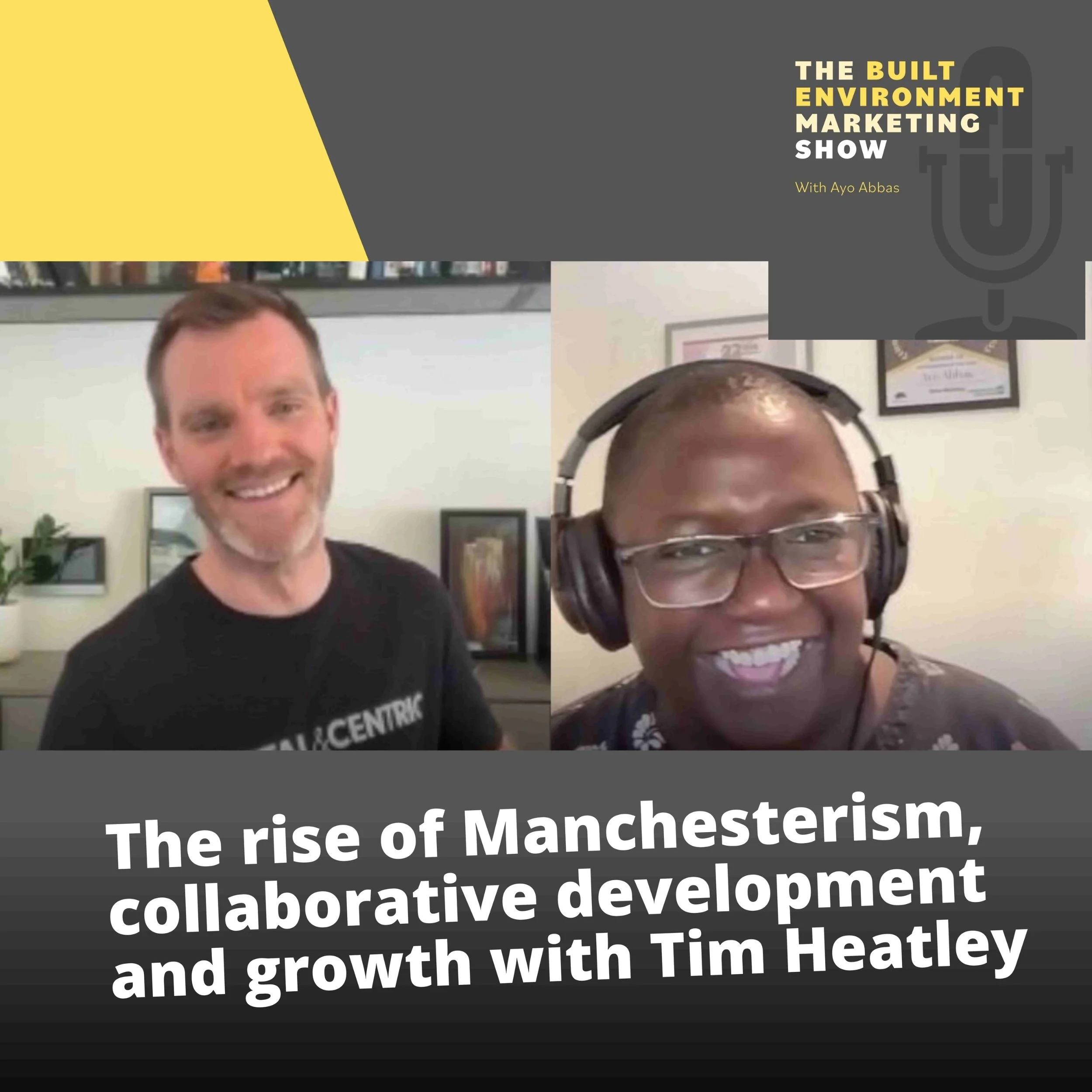
The Built Environment Marketing Show hosted by Ayo Abbas, strategic marketing consultant from Abbas Marketing.
Book an intro call with Ayo
Welcome back to The Built Environment Marketing Show hosted by strategic marketing consultant Ayo Abbas. This week I'm joined by Tim Heatley, co-founder of Capital&Centric, an investor, developer and operator spending three to four million pounds a week on regeneration across the UK.
We talk about how he builds trust with communities before a single plan is shown, why his advice to architects and engineers is to take a naff scheme off their website, and, with the UK's political leadership in flux, what the rest of the country can actually learn from Manchester.
Recorded just before Andy Burnham was confirmed as UK Prime Minister, this conversation already had us talking about the rise of Manchesterism and what the rest of the UK can learn from it. What do you think, could this approach work beyond Manchester? Let me know in the comments.
Don't forget to like this video and subscribe to the channel for more from the people shaping marketing, BD for Architects, engineers and contractors.
Want help with your own marketing and BD strategy in architecture, engineering or construction? That's what I do at Abbas Marketing. Get in touch: ayo@abbasmarketing.com
About the show
The Built Environment Marketing Show is hosted by Ayo Abbas. It is a show that is unashamedly about marketing for architects and engineers, as well as bringing forward voices that we don't always get to hear.
BOOK A CALL TO TALK ABOUT WORKING WITH ME IN 2026
Ways you can support this show
📲 Share about the show on socials
🔗 Follow us on Apple or Spotify
📝 Leave us a review on Apple or Spotify
💬 Tell a friend about the show who you think will benefit.
More podcasts.








Transcript
Tim Heatley 0:00
I think that you know Manchester, as a result of, and when I refer to Manchester, I mean the the city region. Yes, it takes in a whole massively broad demographic of a place, really, and and so what you can expect more of, I think, is you know it's a business-friendly socialism. So that means that what the what the the politicians are looking for there is: Are you a business that wants to do more than just help yourself? Are you there to help yourself for sure? You're a business. You need to do that. But are you prepared to help people along the way? Are you prepared to help other businesses, to help the public, to help non-profits, to help the faith, voluntary charity sectors? You know, are you there? And can you do other things? So, can you do something that might reduce energy bills and make life more affordable, or can you, you know, restore conservation buildings? That's great. We need to do that. Can you create jobs? That's great. We need to do that. Can you create housing that's affordable? We need that. You know, and can you, you know, so it's it's all things that you can do as a in the industry, and it's showing without just tokenistic in a non-tokenistic way. It's showing that you genuinely are trying to help in other areas beyond just lining your own pocket as a business. And the good thing about that is that if you do that well in any town or city or place, then you create a healthy community, a healthy economy, and guess what-that business, your business, can thrive even better.
Ayo Abbas 1:29
That's Tim Heatley, co-founder of Capital and Centric, an investor, developer, and operator spending three to 4 million pounds a week on regeneration across the UK. I'm Ayo Abbas from Abbas Marketing, and this is The Built Environment Marketing Show. We get into how he gets schemes off the ground and builds real community around them. What he actually looks for in an architect and engineer, including taking nav schemes off your website. And with everything going on politically in the UK right now, we also look at what the rest of the UK can learn from Manchester City region. Hi Tim, thank you so much for agreeing to come to The Built Environment Marketing Show. Can you introduce yourself and what you do at Capital&Centric?
Tim Heatley 2:04
Sure. Yeah, I'm Tim Heatley, and I'm the co-founder of Capital&Centric, which is a social impact developer, and we spend between three and 4 million pounds a week on regeneration.
Ayo Abbas 2:13
A week? That's a lot.
Tim Heatley 2:14
Yeah. I don't think about it. That's worrying. Do you
Ayo Abbas 2:20
know what? I worked with the team at New Street, and I remember like towards the end of like the completion of New Street, they were like, "If we're not spending X million a day, we know we're behind on program. And I was like, "Oh my gosh!
Tim Heatley 2:30
Yeah, scary, isn't it? Yeah,
Ayo Abbas 2:33
yeah. No, it really did. It kind of made Brooke to life. I was like, "Oh my gosh, that's a lot.
Tim Heatley 2:37
That's why I say it. I put it in the weekly terms for context. So when I'm talking to my mates at the pub, they get it now. So they stop asking me, "Is it still a good idea to buy a kitchen from Magnet Tim or a bathroom from B&Q? And I say, "I've moved on a bit from that. You know, if the business has grown, I don't know anymore. So yeah, by telling them, "Look, I'm spending three or 4 million good a week here on on on big regenerative projects. They kind of go, they they go, all right, and then they're not interested. They say it's your round, and we move on the conversation
Ayo Abbas 3:04
But that's important, though, isn't it? It's the scale because I think people lose. Like, I mean, I'm really bad at reading like building design plan, like building plans. I can't understand the scale, right? And I think that whole scale thing of actually finding it in a way that people can understand like what what you're talking about, and then the level of it, because because people just don't realize. I don't think.
Tim Heatley 3:24
No, I think, and I'm sure we'll come on to talk about it. But but being able to communicate with people about what's going to happen to their town or city, what's going to happen to their immediate neighborhood, and then putting that in words that means that they can grasp it and understand it, and then and and feedback on it is really important. I think we got good at that over time through, you know, by using by not using property jargon and by not talking about, you know, I say it all the time. You know, we've started on site. Now you say that to somebody in the pub, they go, "What does that mean? I've started on site. You know, we have commenced construction. So it's a very subtle difference thing, but you know, words matter and communication matters.
Ayo Abbas 3:58
So is the pub like your kind of like your kind of research, market research in a way.
Tim Heatley 4:02
Yeah, it's it's the pub test, isn't it? You know, if does does the does the person in the pub who's not that interested necessarily in property or regeneration, can you get them interested in your topic and get them excited about what might be happening to them and their town? And can can you get them to express an opinion? Because at the end of the day, they're the people who are going to use these places and spaces, and it's only by you know extracting from them what they want to see or happen to their place that we can create a successful one. And what what makes a successful place is is the people that occupy, and that is what makes our business successful. So always looking to try and understand what the public are thinking and saying.
Ayo Abbas 4:38
Yeah, I mean, I saw your talk at the AJ Retrofit conference last year, and I think one of the things you started talking through was around, you know, when you buy a site, what's the process you go through in terms of like I guess introducing yourself to your local kind of community?
Tim Heatley 4:52
Yeah, one of the first things we do is we will we meet we we host a meet the neighbors event, and. That's usually during the day. It's it's tea and cake and coffee and a chat. But then into the afternoon and evening, it becomes you know pizza and beers and a bit of live music. And we don't show them any plans. We show them what we've done in the past elsewhere. Lots of photography, lots of imagery, lots of videography, and just telling them about you know broadly speaking the kinds of things we've done elsewhere, what went well, what went wrong? You got to be honest and tell them, you know, where, because they'll go and find it. You know, they'll go and find out where we made a mistake and things didn't go quite to plan, or we had to change something, and then that's building trust and that's building it in a way that you need to do with any neighbor really. And so then, when we do finally come back to them with their first version of the vision for their place, we remind them it's formed by them, and the the best thing about that as well is that if if there's a moaning you know Dave or or a or a complaining Sharon about something, then we can say, well, I know you don't like it, Dave, but the problem is 700 people told us that they wanted this, so I know it's not for you, but it's for everybody, so we can't just ignore all them and just listen to you. So it's how do you find a way of getting to the people who are often a positive and quiet majority who are keen for this to happen, and they need to then drown out the voices of a noisy minority.
Ayo Abbas 6:14
Yeah, and so it's getting that balance. So I mean, what sort of things have you done to kind of get the quiet, quiet, quiet majority kind of to to lift their voice.
Tim Heatley 6:22
Well, it starts with that meet the neighbors, and then and then the ongoing communication with them. And when these people turn back up and see that you've listened to them and you've done the thing and addressed the issue and the challenge that they wanted to see sorted, and it could be very simple, like we want more public toilets. You know, it could be that we want kids, a place, a play area for children. Whatever it might be, as long as they know that, as they can see that we've we've ticked those boxes and we've listened to them properly and implemented it, they feel listened to, and then they become kind of like disciples of what we're trying to do. They go and tell their friends, these guys are good. You know, it's hard to get the public to talk positively about a property developer, but but we're able to do that, and that comes down to how we do things with you know we work we we do a lot on social media. That's great way to inform the public about what's going on, meeting people where they are, finding them where they are, but also working with you know on TV shows or working with the press to you find different places and ways of communicating with people is all vital. And do if you do it well and you do it honestly, then people really do become advocates for you, and that makes our life so much simpler.
Ayo Abbas 7:26
Why don't you think all developers do this, or do you think they don't all do it? Well, something I've always seen people do that well.
Tim Heatley 7:32
No, I mean we've never. I mean the the benefit for us is we've never had a problem with planning. You know we we hear lots of we hear lots and lots of developers complaining about planners and planning, but we don't have an issue with it ever, and that's because I like to think we build nice things and we listen to what people are asking for, and you know you can't, and you're honest with them as well. When they turn up and say we want a museum because this is where that you know that this is where some abstract sport was invented in this little town or village, we say we've got to be honest and say you're not going to get that. It's not going to happen, and and so I think developers are scared of the public turning up and saying we don't want it, we hate it, and we're going to form a Facebook group and we're going to campaign against it, and you're not going to get planning permission as a result. But but I think yeah, and that does happen if you if you don't bring people along with you and you don't you don't go in at the very start and you start you don't start to build a relationship with them, so I would say that it's an old school way as to how it's been done in the past. I'd like to think that there's a new breed of developers coming through that are doing it in a way that is a bit more engaging and a bit more collaborative. So hopefully, it's it's kind of what we're going to see in the future.
Ayo Abbas 8:33
And have you got a scheme where you kind of really kind of went in and you weren't sure if people were going to accept what you wanted to do there, and it helped to kind of turn them around your approach.
Tim Heatley 8:41
Yeah, I suppose there's so many. I mean, many of them. It's not that they're not all kind of like welcome with open arms right at the very start. You know, you know. So because there are controversial elements to it. So if we're repurposing a conservation building, say, then that can go down badly because people kind of feel precious and and anxious about it, and that's good if you can then harness that, and then redirect it back to a positive, which is: look, we're going to do a great job. We'll still be able to access the building because we're going to have I don't know F and B on the ground floor, perhaps, or you know, cafe bars and restaurants, as we as we say, rather than F and B to the public. This is a difference in terminology, and then and so so that that, but equally, when we're going to repurpose a building that's kind of can be seen as a monstrosity, such as a former 1960s kind of modernist civic center built of concrete and almost got vibes, a bruteless vibe coming across, then people are devastated when they hear it's not going to get demolished. So you have to then explain a bit about that and why we're not doing it and how it can look fantastic and you know we often so it's like understanding, for example, we say look if you get rid of all the buildings from the 60s, which is what happened with warehouses and red brick mill buildings back in the 1960s, then eventually you'll be you'll kick yourselves because you'll you'll wish that you had them available to you again. So it's kind of doing a combination of those things. It's it's kind of you know finding out what the what the issues, what the concern is, and then and tackling it head on, and then explaining it to them properly.
Ayo Abbas 10:09
So you you've spoken a lot about kind of communication. So you have a really strong thing to say personal brand, which you do. You you know you're you're often on you do video, you're on TV. How has that helped you as kind of, I guess, your business, and also from a kind of personal perspective.
Tim Heatley 10:23
It's been, it's a blessing and a curse because you know when you know when you're meeting, you know when you're starting a new project and you've got the chief exec of the council or leader of the council, or whether if there's a major headache or a problem on something, it can be a case of where's Tim? You know, can can can we get Tim on this, or where's Tim on the where's where is he? Almost like there can be a, you know, people can forget that there's a massive, brilliant waste martyr team that are doing things, making all the good stuff happen, and so so that's that's the curse of it, I suppose. That and as we've expanded across the UK, and we're right the way in the north, and right way on the south coast. Then that is harder as well to manage because you're physically trying to be in in more of those places at once. That's that's the sort of thing. But the benefit has been yeah the ability of of our growth. I think it's it's not the only reason, but it's certainly one of it's helped to contribute to our growth. It's helped to contribute to our ability to make progress on things, and that's a few different things. So that means that when we turn up in a new town or place, it's easier for people to find out where we've where and what we've done before. There's that there are faces. There's me and colleagues' faces that they can put to the project, and almost by having your face there, it's by being present and by being the person, not a faceless organization. It reminds people that I wouldn't do it if I was planning on clearing off to Hawaii forever with all the money that I've made on this project, and they'll never see me again. Could that be foolish? So, so, so I think it helps people to be reassured, which is and don't. And the other thing is, the other benefit is it's like we're only human, so you know we're a we're a small in a way boutique, you know independent whatever you want to we're family run, you know we're employed by we're we're owned by our by our team, me and my my colleagues, and my co-founder, so it helps to get that across. Which is, look, there will be mistakes. You know, we're not going to get it all right like you. We're not going to get everything perfect, but we won't stop until we do. We'll keep fixing things until it's all correct. So all those things I help, I think, really help make a difference. And it's also been good as well for for me to encourage colleagues to do the same. To say, you know, why don't you get in front of the camera and why don't you work on your own personal brand? Because I think it, you know, people people can instantly want it. What's really nice is I'll go into a meeting and not met the people before, and they already know things about you, which is great. Know things about what you've done, and almost
Tim Heatley 12:56
feel an affinity towards it in the sense that well, they've already decided that point. Do they like you or not? Because if they've seen so much of you on on social or on TV or whatever it might be, that that if they've invited to a meeting, they probably do. And the people that don't like me definitely don't invite me to a meeting. So you you never really end up. That's the great thing. People get to the opportunity to triage you really early on in the process, and you then don't have a conversation with someone that's a waste of time because they might dislike you, and therefore you're given the opportunity to assess that before they've even met you.
Ayo Abbas 13:26
It does. It filters out a lot. I mean, my brand, my personal brand, is not on your scale, but like, but it is. I I do go out to things, and people actually quote me back at the at myself, which is a bit weird, or they ask me questions about my son, and I'm like, how do you know? But like, do you know what I mean? Because I write about him sometimes. So, but I do think that stuff is always like people. Well, people I find with architects and engineers, especially, that they're quite kind of worried about what their peers think about them, so they don't necessarily want to put themselves forward. And I always think that is a really kind of good thing to do because they've got so many great ideas and views and and things they believe in as well, and but it's quite an interesting one trying to kind of get people to feel confident. And in your team, how did you do that?
Tim Heatley 14:06
Well, you find your audience. The other benefit is you find your audience in that I'm absolutely sure that there must be a whole lot of people that find me very irritating, and and they get that's fine, that's fair enough. Get that, and and so and but they don't. But the good thing is, they don't they don't walk over to an event or and say I find you very irritating. They just ignore you and leave you leave you alone. But the people who do find you find what you do interesting, or they do have an affinity towards what you're trying to achieve, then they do come over and talk positively. So I think it's one of those whereby and then colleagues can see that it takes time. You know, it doesn't happen overnight, but that you build an audience over time, and you and that they can do the same. And what they're doing, my colleagues have got, you know, if they want to be able to grow their their personal brand and they want to get on in their careers, not just at Capital Centric, but when they go on to somewhere else from Capital Centric, it helps them a lot if they've got the ability to have. To bring an audience with them on a journey, and so and so they get that, and and as a result, that's taking pressure off me because now they're telling the story about what we're doing at Captain Centric. They're they're sharing those ideas, they're sharing some of the behind the scenes things as well, and and that's helping me and and us as a business as well continue to expand and grow. But it's also mean it also means that that that stuff's out there, that content's out there for them forever to use in their future career.
Ayo Abbas 15:24
That's so so true. The amount of people I see now who are I used to work for Stephen Bartlett. It's mad. Everywhere I'm really like, is there anyone who didn't work for Stephen Bartlett? Yeah, I did at
Tim Heatley 15:34
one point in the past. Yeah, I think I must have worked for Stephen at one minute.
Ayo Abbas 15:37
You're in Manchester. You could have done. Yeah. So I was going to say, so when you're making your videos, because like your your kind of walk and talk videos are brilliant, and I remember one of my friends, Stacy, she kind of introduced me to you, and I was like, oh my god, I was like really good. How do you do them? What's your process of actually production of producing?
Tim Heatley 15:56
I mean, I mean, for for a kid, I don't use a selfie stick, and I don't know if this is, I don't, I don't know if you screen the video of what you do, but I'll just give you. It's this. It's just my arm at full length with my phone, and I don't even use much of the frustration of colleagues in the marketing team. I don't use a mic, an lapel mic or anything. I just use the mic on the phone, which isn't great. You know, it's a bit noisy, a bit blustery, a bit windy, especially on a construction site as well. Which I was going to
Ayo Abbas 16:19
say, 20 quid on Amazon, right?
Tim Heatley 16:22
Yeah, I'm I'm a deeply disorganized individual, and that would take some planning, and and so I don't know when I'm gonna I don't know when I'm gonna do a video. I just, but it just you know yeah. So I'm a bit. I need to get better at that anyway. So it's as simple as, and then I'll and I'll do that, and I'll go right. There's because there's something that I want to say, or that there's something of interest to me, you know. So I do that, and then and then typically I have to do it like three or four times because I try and do it as one, one edit, one cut right the way through. Yep. So you don't have to kind of like it's not so it's not difficult then to be edited. Other than what I also do is just ensure I also will whilst I'm there, I'll take some B roll as I call it, which is you know footage of just the whatever whatever's going on the background of whatever I'm talking about, and then that can be cut in because frankly people are bored of watching my face. Yeah. So cutaways of what we're actually what I'm looking at, in addition to some CGIs of what it will eventually look like, help a lot. And and then that combination seems to you know seems to keep people interested, and and and so yeah, it's pretty simple. And but yeah, I've got a colleague in the marketing team who's one of their main roles is to edit and and create the content. Yeah, not just for me. Obviously, they're doing it for. We've got other brands, so they do it for Ollo, which is our residential management brand. They also do it for. They also work for a couple of non-profits that I'm involved in. Regeneration Brainery is one of them, and there's a few other charities, a couple of which I chair. That that that they pro bono. You know, we provide some content creation services to those places as well. So it gives, which is good for them. You know, variety is good for creative people. You know they need variety, and so it helps both. You know it helps the charity, but it also helps it helps them keep interested.
Ayo Abbas 18:09
But it's also really interesting because I think that whole thing about video communication and how much more accessible it is now, and literally you can just do it from your phone, and it doesn't need to be a massive production process. And I think that's another major opportunity there, isn't it? And it's how people connect as well, right?
Tim Heatley 18:24
Yeah, it's very simple. I mean, I didn't used to have a colleague to help me edit the videos. I just used to do them and just do as one take, you know, less than 60 seconds if I ever could. Yeah, and then just pub and publish that, and it was me just doing it, and it's dead simple and that easy. Over time, you know, if you want to evolve and improve the the quality of them, you know, there's that extra support that I've got there, but but but yeah, keeping it simple and easy, and increasingly because everybody can be an expert because of because of we've got access to AI that can help people sound and be expert in many ways. I think the authenticity of having somebody you know with their arm stretched out on the phone saying what they think and believe, and without it being too, you know, overgenerated or overedited or overcontrived, I think helps a lot. So that you know, for a fact, really, that me and my colleagues that are sharing that content is that that is that is genuinely their belief, that is genuinely their knowledge. That is genuinely their understanding. You might disagree with it, but it's at least it's it's what it's genuine, and it's not some piece of software that's that's that's giving the opinion. And I think increasingly that's going to matter to future generations to be able to do that and communicate that well. That's going to be premium. You know, people will be premium, and that's ultimately what you can be paying for in the future, which is at the minute almost it's kind of premium is premium is is is kind of not necessarily the individuals, but personality will be premium in the future. Yeah,
Ayo Abbas 19:52
yeah, no, I think so. If I say that with the creative economy, it's got to be about the people now because everything else can just be made by AI, which is great.
Tim Heatley 20:00
It's an averaging thing. AI averages everything out. It can be it can be great, but also at the same time creatively, it's mediocre. Yeah,
Ayo Abbas 20:08
I kind of it's like lots of creators whose stuff I used to love, and I'm like, your voice has changed, and you you seem to be lost in like AI in the AI world. I think it's really sad. I'm like, where are you under there? It's happening a lot. So, in terms of architects and engineers who want to be involved in kind of developments and working with developers like Capital and Centric, what do you look for when you're kind of looking to choose an architect and engineer, and what what kind of things stand out to you, and what do you want from them apart from great design?
Tim Heatley 20:38
We get we get a huge amount of incoming from architects and engineers, he'll say, "I see that you've acquired a project, or you're doing something in a town near and city near us. Can we can we get involved? But then it's way too late because by that point, by the time it's in the press, it's you know we've got a team assembled, so that's always the case. And that's the first thing. The second thing is my favorite. My favorite architects and engineers are those that introduces opportunities that are really good opportunities that understand that tells me straight away that they understand what it is we're trying to achieve and what it is that we're trying to do. If they if they say I know of a project that you would be perfect for, and I know the right people to put you in touch with to make that happen, that's a big tick in a box for us as well. So you know, rather than just messaging me on LinkedIn, which I get a lot of, and you can imagine just people saying, "Oh, can I have a job? I think that's just not the right business development topic for me. And then, and so, and then that's the first thing. Then, in an architect, truth of the matter is as well. We often will look at an architect's website, and we're looking for excellence, and we're looking for, you know, one of our key tests is: is it an RIBA award-winning kind of quality of product? Because many of our schemes do win those sorts of architectural awards, which we you know we value highly. That's important to us. Third-party judged, you know, housing design awards is another good example. Yeah, and so we'll look for that. And and if we see, I always say to architects like, if you can, well, I always say, if you've got a scene that's a bit naff, just take it off your website, because the fear for me as somebody that's appointing architect is when I hit the my head hits a pillow at night, I don't want to be worried that my project is going to be one of the naf ones. I want the architect to be worrying when their head hits the pill at night. To be worrying how they make Capital-centric project exemplary, because that's one of the key signifiers of our brand is design, you know, excellence. That's helped us grow. That helps us get plan permission. That helps us get more people keen on attracting us to do projects in their city and town. So I would say, if there's something naff, take it off because I've seen architects websites where they got loads of brilliant stuff, and then they got something that's really a bit rubbish. And I think, ooh, I can't leave you to just get on with it if I think that you might make a mistake and do something like that. So I take it off, and you don't need to have loads and loads of things on your website. I always think that's a big turn off as well. When there's loads of projects, just do, just focus on your top top five, and just say these are the ones that are that's the best sort of architecture we can do. Because again, you don't always have a client that lets you do your best work, but when you do, then you should really celebrate that and tell people about that and use that as your hook, and then and then say then you say to the client, this is what I'll do for you if you let me do a really good job.
Ayo Abbas 23:19
Often we talk about showcasing the kind of work work where you want to get to, so you know the stuff that's going to actually help take your business forward, rather than because I think sometimes everyone wants to show everything. It's like no, and then leave you to be the filter, which takes a lot of time, and people just don't have that level of time.
Tim Heatley 23:34
No, exactly. So, for example, we have got projects that we did was Embionic, where I was building warehouses and on office parks. Now, as far as warehouses go, they were brilliant, excellent, and they were, and they had architectural. They were miles cooler than the stuff that was around it. But equally, it's not. You know, I don't want to be doing warehouses. Didn't want to be doing warehouses. This is going back to 2007 and eight, and so I was like, I'm not gonna. It's not on the website. The stuff that is going to be on the website is going to be the stuff that I want to be doing more of. And yeah, you're right. Focus on that stuff.
Ayo Abbas 24:07
So, do you think architects and engineers understand what developers want?
Tim Heatley 24:10
Yeah, I think they do. I think I think some do better than others. I think there's a spectrum of what architects and engineers want. Yeah, I think that because I suppose it's difficult because developer clients are all so different. So much of what we do is in partnership with the public sector. What we want really is is not exclusively, but but but so much what we do. Certainly two thirds of what we do is collaborating with a local authority and council, and maybe a combined authority and central government to bring about big change and regeneration, and so that's tricky because in a way the architect or the engineer would need to know the right people at that combined authority or local authority and have a relationship with that individual at the combined authority, say or the council, to be able to say you really should be working with capital and centric on this. You know, there's probably little point if if they haven't got. The relationship there with the council say because otherwise that's not really much of a warm introduction. It's just it's just an email address and a bit of a kind of a fairly faint sort of relationship. So that's no good. But I get it. It's difficult for you know that's what we want as cabinet centric. But equally, the next developer wants to build a food store, and the next developer wants to build unit flats. So I think it's hard for them because they probably are trying to cover lots of different bases. And again, if it were me, for personally, I'd focus and specialize. I try not to do everything. I'd try and go, and we're going to just do this. I'm going to do this really well, and we're going to become the best at it. I think that's what we did as capital-centric. I think we just said we're going to focus on this sort of thing and do really, really well. It'll take time, and it did. And and you know, because we're not, you know, people often think of us as being a bit of an overnight success, but we we have been doing it for, God, it's coming up to near 18 years or something like that now. So before you know it, it'll be 20 plus. And so, yeah, add focus and and really just tune in exactly on what you want to do, who you want to work with, and don't try and be everything to everyone.
Ayo Abbas 26:07
Is there any way that people can not be political in our industry? I'm just thinking, like for example, Jay Morton, who's who's obviously ran her campaign to become incoming Libra president, and she's like kind of pushing the idea that everyone has to be political, which I do agree with. Is that something you think that actually people need to be aware of what's going on?
Tim Heatley 26:25
Yeah, I think I think being aware of. I mean, one of the things that we've always done well is understood what the government's agenda of the day is and focused on that. So, be it around employment creation, which is what I mentioned right, you know, early on about building warehouses and office parks, was because at the time the government were absolutely desperate to create jobs, and one of the ways that they saw that was creating workspaces and employment spaces. So, so that's important. But then, then that pivoted into densification of urban areas and brownfield first, and and then it and then so we started to do that again a lot in the office and workspace sort of area, and then it came, and then over time, there's always like blips of up and downs of carbon neutrality and low carbon. It goes up and down on the agenda, and it always comes back stronger. By the way, so you know, green green initiatives get stronger. Now, green
Ayo Abbas 27:13
infrastructure-that's what it is, isn't it? Yeah, and then it
Tim Heatley 27:15
comes back stronger, and it goes, and and then it goes off. It it goes up and down depending on how how how how the economies are doing at the time, and so but it always comes back stronger. It does come back, and then and then it pivoted the government agenda. Then pivoted to homes, and then it pivoted now. Now it's pivoting very much to affordable homes and social homes. So it's always been aware of that. What's coming up next on the agenda? And so I think it's worth being political in the sense that you know, as a development company, we work with and working with the Luke Campbell up in you know up in Hull. There he's a leader of reform there in the at the Combined Authority. He's the mayor, sorry, of the combined authority. But equally, you know, I'm working with the the Tory mayor Paul Bristow in Cambridgeshire. I'm working with Kim Mcguinness, Tracy Brabin, Andy Burnham, Steve Rotheram-they're all Labor in other parts. So, and it's the same locally as well. We've got Lib Demly, doesn't have got Labor. So we get on. We've got to understand the politics of a place in an area if you're going to be successful. And you've got to. We always set the view, which is the public have elected them to be representative of the public. That's what the public have asked for. That's what the public wants. So you do well as a business to give the public what they're asking for. So,
Ayo Abbas 28:28
and who are you to judge, right? Yeah, yeah.
Tim Heatley 28:32
That's you know that that's how democracy works. So it's like right. That's what they've all asked for. That's what they want. That's what representing their views. What would you like to see happen? What is your view? And we'll do that because we go with the grain development business. We're not going to get in the way of it, and as a result, you know, surprise, surprise, if you're not looking to be difficult, and if you're trying to focus on what the political priorities are in that place and try and fix those problems that they've got for them, then surprise, surprise, you can you get along a lot quicker and you can make far more progress. So I think it is worth understanding it and getting yeah getting involved in it.
Ayo Abbas 29:04
Okay, so obviously our current political leader has resigned, and for the for the UK, and I guess the the focus is turning to Manchester and Greater Manchester. What do you think the rest of the UK can kind of learn from the region?
Tim Heatley 29:20
I think that you know Manchester, as a result of, and when I refer to Manchester, I mean the the city region. Yes, it takes in a whole yeah massively broad demographic of a place, really, and and so what you can expect more of, I think, is you know it's it's a business friendly socialism, so that means that what the what the the politicians are looking for there is: Are you a business that wants to do more than just help yourself? Are you there to help yourself for sure? You're a business. You need to do that. But are you prepared to help people along the way, or are you prepared to help other businesses, to help the public, to help non-profits, to help the faith, voluntary, charity sectors? You know, are you there? And can you do other things? So, can you do something that might reduce energy bills and make life more affordable, or can you, you know, restore conservation buildings? That's great. We need to do that. Can you create jobs? That's great. We need to do that. Can you create housing that's affordable? We need that. You know, and can you, you know, so it's it's all things that you can do as a in the industry, and it's showing without just tokenistic in a non-tokenistic way. It's showing that you genuinely are trying to help in other areas beyond just lining your own pocket as a business. And the good thing about that is that if you do that well in any town or city or place, then you create a healthy community, a healthy economy, and guess what? That business, your business, can thrive even better. So, in a way, it's it goes full circle anyway, and I think that's what it is. It's looking at things as a whole and saying, is there a way that we can all benefit from this? And if there's anybody in there that we can weed out that's only looking to help themselves, then we need to just single them out and say not you thanks very much. That's kind of the Manchester way. It's it's been built on that because it's needed to be resourceful. It's needed to be pragmatic about about what can happen. And it said okay, well I get it that this might not make a you know because of where we are and what we've got available to us, this might not make a massive return for let's say the council's providing some development finance towards the cost of some doing something, but the council will say, well, well, can we get a bit of a park out of it as part of it? Can we get all our money back and a park? So we don't need a big return, but can we get this and that? And that's the difference. Is like, well, what else can we get out of this process? And and it's looking at things in in a more holistic way, it's looking at social value and outcomes and outputs more than just the financial bit, and and it's been super successful for Greater Manchester. And by the way, it started it started a long time ago. This it started before the current leadership and before the leadership before that, and the leadership before that it started you know a couple 100 years ago, perhaps, and it's just in the psyche as a result. And you don't have to be from Manchester to, you know, to know it or be part of it, because most people aren't. You know, most people like my grandparents are immigrants that came over here and settled in Manchester and got on, and and and that that's the Manchester way. If you if you turn up and you want to help out and you want to leave the ladder down for others and you want to put a shift in, then you are a Mancunian and you are you know welcome with open arms. And we need more of that. Yeah,
Ayo Abbas 32:33
fantastic! That's a brilliant way to end the podcast. Thank you so much for coming onto the show, Tim. Hope you enjoyed. I
Tim Heatley 32:38
really enjoyed it.
Ayo Abbas 32:39
Awesome.
Tim Heatley 32:42
Thanks very much.
Ayo Abbas 32:42
If you enjoyed this, hit subscribe. There's a new episode out every two weeks, and you can also catch us on Spotify and Apple if you prefer listening. If you're an architecture, engineering, or construction firm looking to work with a marketing consultant who knows your world, do head to Abbasmarketing.com, linked in the description, to find out more. Thanks so much for watching. See you next time.
This transcript was generated by https://otter.ai